
By Yurong Gu, Vice President, Product Index Innovation, STOXX; and Dr. Andrew Ang, Co-Founder of Tau Balance and Adjunct Professor at Columbia University.
You can’t judge a book by its cover. Likewise, you can’t judge a company by its book value.
The premise of value investing is simple: buy cheap relative to intrinsic value. Traditional measures of intrinsic value were based on accounting metrics like a low price-to-book or a high earnings yield. But today, brands, intellectual property and the size of customer networks drive much of a modern company’s value — yet they often don’t directly show up in accounting statements.
To get a more complete picture of value, the recently launched iSTOXX Ang Research Enhanced US Large Cap index builds on two distinct Value factors: Cyclical Value — based on the traditional book-to-market ratio and earnings yield — and Enhanced Value. The index is a multifactor combination of Value, Momentum and Quality, with factor timing. (You can read more about this here: iSTOXX Ang Research Enhanced index family – Market Similarity for factor timing).
Enhanced Value metrics
The Enhanced Value factor is a composite of three signals:
- Economic Profit Yield is the ratio of Economic Value Added (EVA) divided by Enterprise Value. EVA first reverses accounting distortions, then deducts the full cost of capital demanded by shareholders and lenders. Using EVA can expose cases where rising earnings hide value destruction: a firm with high accounting profits is not cheap if those profits merely compensate investors for a large capital base or a high cost of capital.
- Intangible Asset Ratio is the share of a company’s total capital that is intangible.
Intangibles are a form of “hidden value” that balance sheet metrics like book value do not capture. It includes reported intangible assets plus capitalized research and development (R&D), and advertising and promotion spending. Accounting rules (GAAP and IFRS) require these outlays to be expensed immediately. We instead treat them as investments and amortize them over time. Counting intangibles matters for all companies: almost half of the typical US firm’s capital is intangible, and most of it never appears on the balance sheet. Intangibles’ share of corporate assets has risen by about 30 percentage points since the mid-1990s.[1] This adjustment especially matters for technology companies, whose economic value is built more on intangibles than on physical assets. - Free Cash Flow Yield is the ratio of Free Cash Flow to Enterprise Value. Free Cash Flow Yield reflects a company’s underlying financial health, providing a more reliable indicator of whether a “cheap” stock reflects genuine cash generation ability, which is inherently less susceptible to manipulation compared to earnings or book value.
Enhanced Value vs. Cyclical Value
To compare the new Enhanced Value with traditional Cyclical Value, we built a long-only portfolio for each one that maximizes exposure to that factor’s score. Both portfolios have the same 1% tracking error budget and benchmark-relative constraints similar to those used in the multifactor index. Figure 1 shows that the two factors behave very differently from year to year, which justifies holding both Value factors.
Figure 1: Active annual returns, 2003–2025
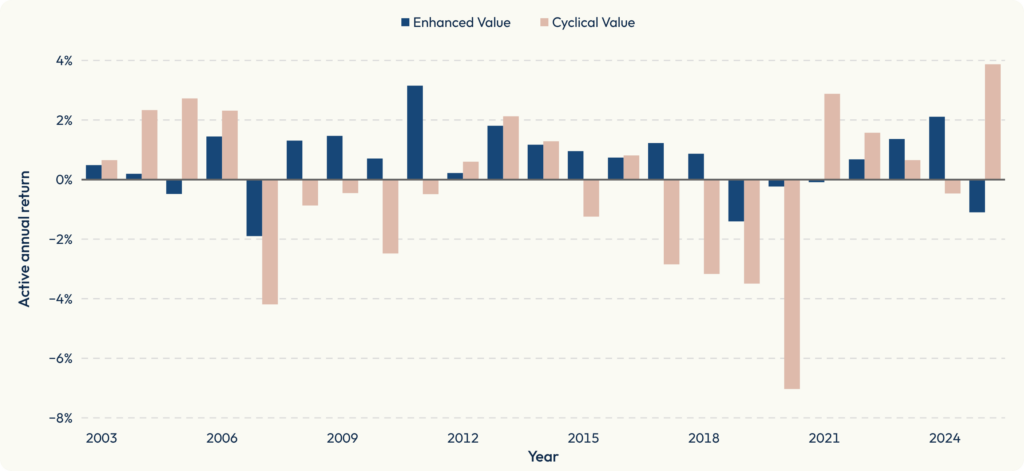
In periods of Cyclical Value underperformance — notably 2007-2011 (during and post-Global Financial Crisis) and 2017-2020 (pre-COVID) — the Enhanced Value strategy holds up considerably better.[2] In years where Cyclical Value stages sharp recoveries, Enhanced Value tends to lag. Therefore, having both Value factors in the multifactor index offers a compelling diversification benefit.
Differentiated constituents
The stocks where the two Value factors disagree most are asset-light, intangible-rich companies: Enhanced Value rates them as cheap, while Cyclical Value rates them as neutral or expensive.
Figure 2 lists the three constituents in the STOXX® US Universal index with the largest differences between the Enhanced Value and Cyclical Value scores as of September 2026. These companies share a common characteristic: they operate highly asset-light business models and derive a significant portion of their enterprise value from intangible assets such as brands, platforms, intellectual property, customer network and long-term contractual relationships.
Figure 2: Constituents with the largest score difference as of September 2026

- Booking Holdings: It is a platform business whose value is driven by its brands (Booking.com, Agoda), technology, network effects, data and customer relationships, rather than owning physical hotels.
- Hilton Worldwide: Hilton follows an asset-light franchise and management model, deriving much of its value from brands, franchise contracts and management agreements, rather than real estate.
- Spotify Technology derives its value from its platform, user base and recommendation algorithms, rather than tangible assets.
Book value was a good guide to what a company owned when its wealth was in factories and inventory. Today much of that wealth is in intangible capital, which book value does not see. Enhanced Value measures these intangible assets, and Cyclical Value keeps the traditional measures. The two Value factors are different, so there is diversification in holding both.
References
Ang, A. (2023). Trends and Cycles of Style Factors in the 20th and 21st Centuries. The Journal of Portfolio Management Quantitative Special Issue, 49(2), 33-56. doi:10.3905/jpm.2022.1.455
Crouzet, N., Eberly, J. C. (2019). Understanding Weak Capital Investment: The Role of Market Concentration and Intangibles. National Bureau of Economic Research (NBER), Cambridge, MA.
Peters, R. H., Taylor, L. A. (2017). Intangible Capital and the Investment-q Relation. Journal of Financial Economics, 123(2), 251-272.
[1] Peters and Taylor (2017) and Crouzet and Eberly (2019).
[2] Ang (2023) shows that the pre-COVID value drawdown was the worst in close to a century of data.