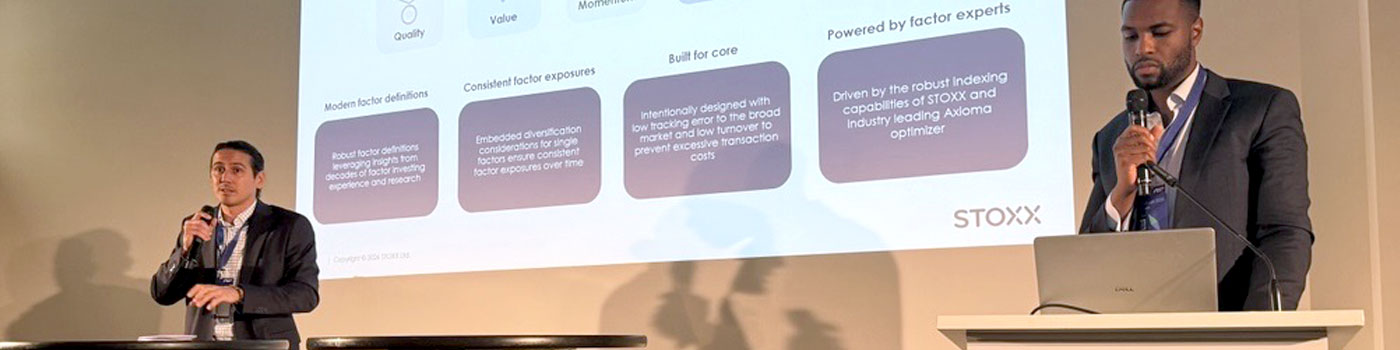
Deutsche Börse hosted its annual ETF Forum in Frankfurt on October 27, gathering another strong lineup of speakers and a large audience drawn from across the investment community.
STOXX was represented by Ladi Williams, Head of Thematics and Alternative Strategies, Product Management, who shared the stage with Omar Moufti, Product Strategist for Sectors, Themes, Factors, Commodities and Crypto at BlackRock’s iShares, in a presentation entitled “Beyond Traditional Benchmarks.” They discussed three ETF families the two companies have recently collaborated on, designed for a market in which investors seek not only returns but also differentiation.
STOXX Focus indices
The first were the STOXX Focus indices, part of the STOXX Thematics suite. The indices underlie six iShares ETFs, which have been shortlisted for Innovative ETF of the Year at the 2026 ETF Stream awards.
The indices segment key regional benchmarks by revenue exposure, creating “Domestic Focus” and “Foreign Focus” baskets across five major markets. Based on FactSet GeoRev data, the Domestic Focus indices include companies that derive at least 50% of sales from the target market[1], while the Foreign Focus indices exclude them.
Figure 1: Available STOXX Focus indices

The STOXX Focus indices were born out of the premise that in a globalized economy, a company’s country of domicile may not matter as much as where its revenues are generated. For example, Moufti mentioned that US and UK companies earn around 42% and 77% of revenues abroad, respectively. Domicile or listing — long traditional criteria for stock selection and portfolio construction — has become a less reliable indicator of risk and diversification.
Moreover, today’s markets are driven by tariffs, FX, geopolitics and growth differentials — factors that affect those revenues generated overseas. In this environment, the STOXX Focus indices allow investors to express both tactical and structural macro views, and achieve meaningful geographic diversification, explained Williams.
“For instance, if you’re bullish on domestic consumption, you would go for the Domestic Focus index,” said Williams. “If you’re bullish on global trade, it would be the Foreign Focus index. What this does is create very distinct portfolios,” he added, all within the same traditional benchmark.
“Usually, the first port of call for an asset allocation decision is to overweight or underweight specific regions,” said BlackRock’s Moufti. “That poses a problem. You’re effectively taking two bets when allocating via traditional regional indices: a bet on domestic companies and one on companies that are global. It’s become very hard to do macro-to-micro implementation when broad, market-cap-weighted indices are oriented toward the largest companies, which are the ones that have succeeded globally.”
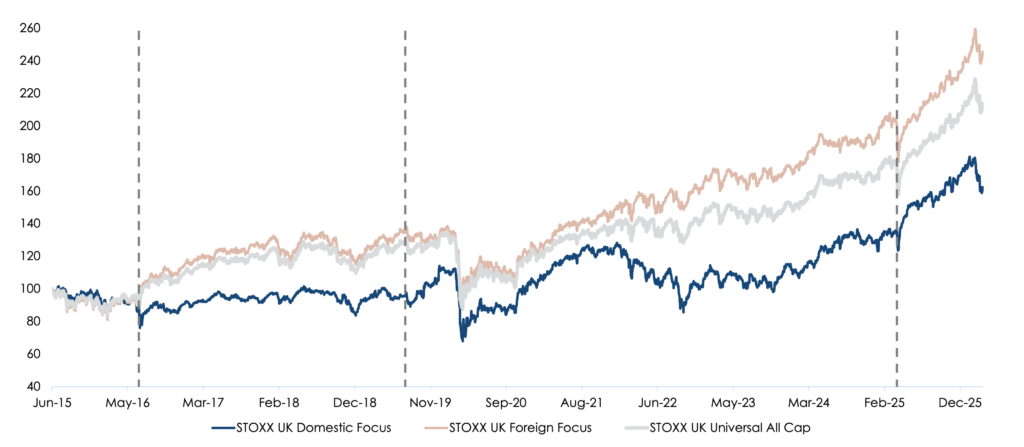
Earlier this year, we reported how the Domestic and Foreign Focus indices for the same region have diverged at times, driven by macroeconomic events. Williams cited the example of the STOXX® UK Foreign Focus index, which outperformed its parent benchmark by 8 percentage points in the 12 months following the June 2016 Brexit vote. Meanwhile, the STOXX® UK Domestic Focus index beat its parent by 14 percentage points in the seven months following Boris Johnson’s appointment as Prime Minister (Figure 2).
Figure 2: STOXX UK Focus indices
The discussion around the STOXX Focus indices was timely. An earlier session with speakers from TS Lombard, BNP Paribas Asset Management and Allianz Global Investors discussed how geopolitical tensions, inflation and shifting growth expectations are clouding the global economic outlook and creating a complex investment environment.
That impact is being felt differently across regions, complicating the “macro-to-micro” implementation that Moufti referred to.
Enhanced factor signals
The second product suite discussed was the multifactor range of iShares ETFs that track the STOXX Factor Screened indices. The indices, introduced in 2024, are constructed by maximizing their exposure to a multifactor alpha signal while satisfying a set of constraints intended to closely track their parent benchmarks. The multifactor signal is built from 16 proprietary metrics devised by BlackRock and combined into five factors: Momentum, Quality, Value, Low Volatility and (Small) Size. The methodology is designed to capture rewarded investment characteristics using both traditional and innovative insights.
The first goal of the indices, BlackRock’s Moufti explained, is to offer investors consistent exposure to drivers of long-term excess returns, avoiding the inherent pitfalls of certain factors falling in and out of favor over a market cycle.
“The second goal is to enhance the drivers of those factors: bring new signals that have been tested academically and that can deliver persistent alpha,” Moufti said. “The third one is to bring it all together in a comprehensive, risk-managed portfolio.”
Williams described some of the novel factor signals used in the methodology, and explained that a final-stage optimization of the portfolio maximizes the exposure to the multifactor signal while also ensuring the index doesn’t deviate too much from the benchmark.
“All of this is done in a rules-based manner so that portfolio managers can benchmark themselves and see how or where the performance is coming from,” he said.
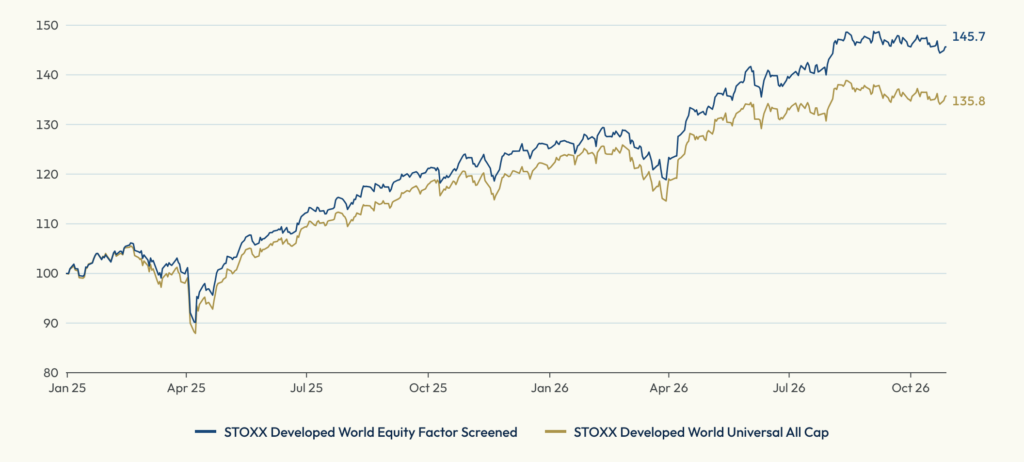
The STOXX Factor Screened indices have outperformed their benchmarks in global, US and European portfolios in the past year. The STOXX® Developed World Equity Factor Screened index has returned nearly 10 percentage points more than its benchmark since the start of 2025 (Figure 3). A recent STOXX analysis showed that the outperformance has been driven by the proprietary factor signals designed by BlackRock and integrated into the STOXX indices’ methodology, rather than other, standard factor signals or industry tilts. Moreover, the extra returns have come with lower volatility.
Figure 3: Index performance
As factor investing evolves and becomes more sophisticated, it is getting increasing attention. A net EUR 116 billion was invested globally into factor ETFs in the first nine months of this year, according to STOXX data.
AI across the value chain
Finally, the conversation veered toward the theme of AI, a topic that appeared across various panels throughout the day, discussed both as an investment theme and as an investment tool.
On AI as an investment theme, Moufti explained that BlackRock views the “AI economy” as a broad, multilayered phenomenon that affects different industries in different ways and at different stages. The left-hand side of Figure 4 shows this ecosystem as a stack, rising from the AI enablers at the bottom, such as power and accelerated computing, to the AI adopters at the top, such as applications and services.
Figure 4: The iShares AI Ecosystem
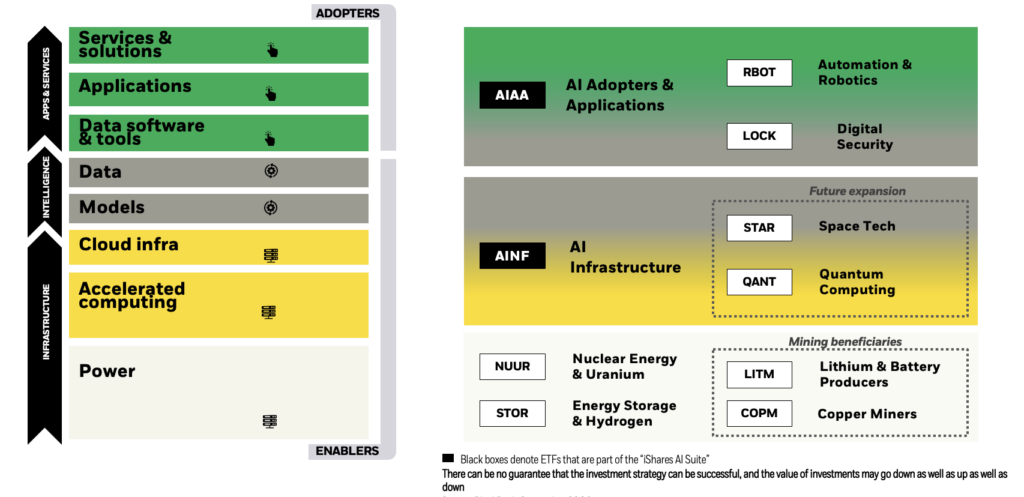
The right-hand side shows ETFs launched to capture the economic upside of each layer of this megaforce. The segmentation between AI infrastructure and AI applications represents two very distinct thematic betas for investors, Moufti said. BlackRock and STOXX have collaborated on thematic ETFs covering the two segments.
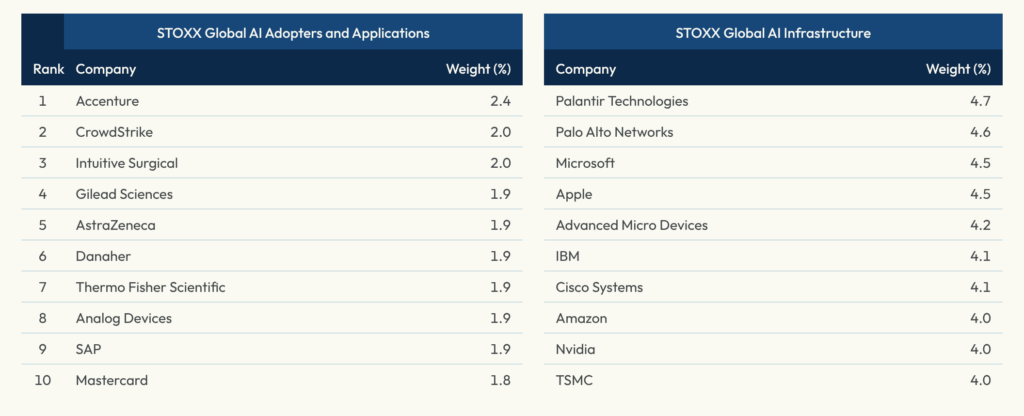
Figure 5 shows the ten largest companies in the two indices underlying those ETFs: STOXX® Global AI Adopters and Applications, and STOXX® Global AI Infrastructure.
Figure 5: Ten largest constituents
“We’ve developed a very comprehensive range to capture the AI opportunity, and there’s a good chance that, over the next three to five years, the outsized returns that can be generated are somewhere on this slide,” said Moufti, referring to Figure 4. “The AI theme, or megaforce, has a long runway ahead of it.”
Data as a driving force in portfolios
If the theme linking all three strategies discussed is precision, there is also a common thread enabling them: data. As investors seek targeted exposures and pursue alternatives to traditional benchmarks, structured information will become key in developing new indices and constructing portfolios, the panelists said.
“Data is changing the investment landscape — it is a world of opportunity,” Moufti concluded. “For a market where the cost of getting beta has become so low and so seamless, it is imperative for the asset management industry to deliver more complex, precise and granular portfolios.”
German pension reform
Fittingly for a Frankfurt event, another topic dominated conversations on and off stage this year: Germany’s upcoming pension savings reform.
Germany has approved a new retirement savings account, the so-called “Altersvorsorgedepot”, as authorities seek to turn Germans, as DWS has put it[3], from a nation of savers into one of investors. For the first time, the range of products available in the account will include investments without a mandatory capital guarantee, opening the door to return-oriented vehicles such as ETFs and mutual funds.
A main-stage panel, “The Altersvorsorgedepot: A game changer for retirement savings?”, brought together speakers from DWS Xtrackers, online broker flatexDEGIRO and Deutsches Aktieninstitut, the association representing Germany’s capital markets. They discussed the opportunities and challenges of the new account, and how to get more people to build long-term wealth with ETFs and other securities.
The subject will only gain prominence as the reform takes effect on January 1, 2027. Asset managers, ETF issuers and index providers are preparing for a potential surge in demand as German savers embrace the new accounts. To offer investors comprehensive market coverage, STOXX recently expanded its benchmark lineup with the launch of the STOXX Investable Market Indices, adding to established market references such as DAX®, EURO STOXX 50® and STOXX® Europe 600.
A fixture on the European ETF calendar
Deutsche Börse’s ETF Forum has become a fixture of the calendar for ETF issuers, investors and intermediaries from across Europe and beyond. This year’s strong attendance and caliber of speakers reflected an industry brimming with innovation.
* Quotes in this article have been edited for clarity and brevity.
[1] Domestic Revenue is defined as revenue generated from the region of the parent index.
[2] The 16 metrics span five factors. Momentum: Earnings Announcement Drift, Earnings Momentum and Price Momentum. Quality: Accruals, Dilution, Gross Profitability, Change in Net Operating Assets (NOA), Carbon Emissions Intensity and Science-Based Targets. Value: Book Yield, Cash-Flow Yield, Time-Series Normalized Cash-Flow Yield, Dividend Yield and Earnings Yield. The remaining two factors, Low Volatility and Size, are made up of one metric each.
[3] DWS, “10 Themes – #4: Can pension reform change how Germans invest?” October 27, 2026.