
The SimCorp Global Summit 2026 took place on April 22-24 in Copenhagen and offered the latest opportunity to explore the evolution of smart indexing.
As units of Deutsche Börse Group, SimCorp and STOXX together offer a broad range of solutions serving asset managers worldwide. SimCorp is a leading front-to-back investment management platform. STOXX provides some of the world’s most widely used indices to over 550 companies globally. These services are complemented by the offering of other Group companies, including ISS Sustainability (ESG data), Axioma (portfolio construction tools and portfolio analytics) and Eurex (trading and clearing of derivatives).
STOXX participated in two discussion panels at the Summit. The first one, featuring Armelle Loeb, Head of Index Sales EMEA and Member of the STOXX Executive Board, examined the current state of index investing — a popular topic given the continued growth of passive investing and the increasing sophistication of index-based strategies.
An index as the center of an ecosystem
Loeb explained during the panel that a successful index is one that has developed a wide ecosystem around it, encompassing an extended suite of derived solutions, liquid investable products, strong brand recognition and easily accessible data.
“Investors need confidence that the index is objective, replicable, and stable over time,” said Loeb.
She also highlighted the importance of the trading ecosystem. “When an index is supported by liquid derivatives, it becomes a true institutional benchmark,” she said. “Liquidity reinforces adoption, and adoption reinforces liquidity — it’s a virtuous circle.” Scale matters equally on the product side, she added. “Once assets under management grow and secondary market liquidity develops, the index becomes embedded in allocation frameworks.”
Globally, assets invested in passive ETFs grew 16% to EUR 15 trillion in 2025, according to STOXX data. Total assets in ETFs tracking STOXX and DAX indices climbed 51% to EUR 189.1 billion last year, following net inflows of EUR 35.1 billion. The EURO STOXX 50® and STOXX® EUROPE 600 benchmarks led inflows.
Customized and client-specific
It has been a period of intense activity for index providers, and Loeb noted that research and development across the industry show no signs of slowing. That will result in an increasing number of benchmarks as well as indices covering new asset classes such as digital assets.
Recent client demand remains focused on climate-aligned and thematic benchmarks, factor-based integration and outcome-oriented strategies. An overarching characteristic of many new solutions is that they are customized and client-specific, Loeb said. STOXX’s collaborations with ISS Sustainability Solutions and Axioma have respectively strengthened its data and portfolio construction capabilities, enabling the development of many next-generation benchmarks, she added.
4D investing
Another panel took a closer look at how some of those next-generation strategies work in practice, drawing on a compelling case study: a recent collaboration in which STOXX and APG[1] — one of the world’s largest pension investors, headquartered in the Netherlands — designed a customized index solution built to straddle investing’s efficient frontier.
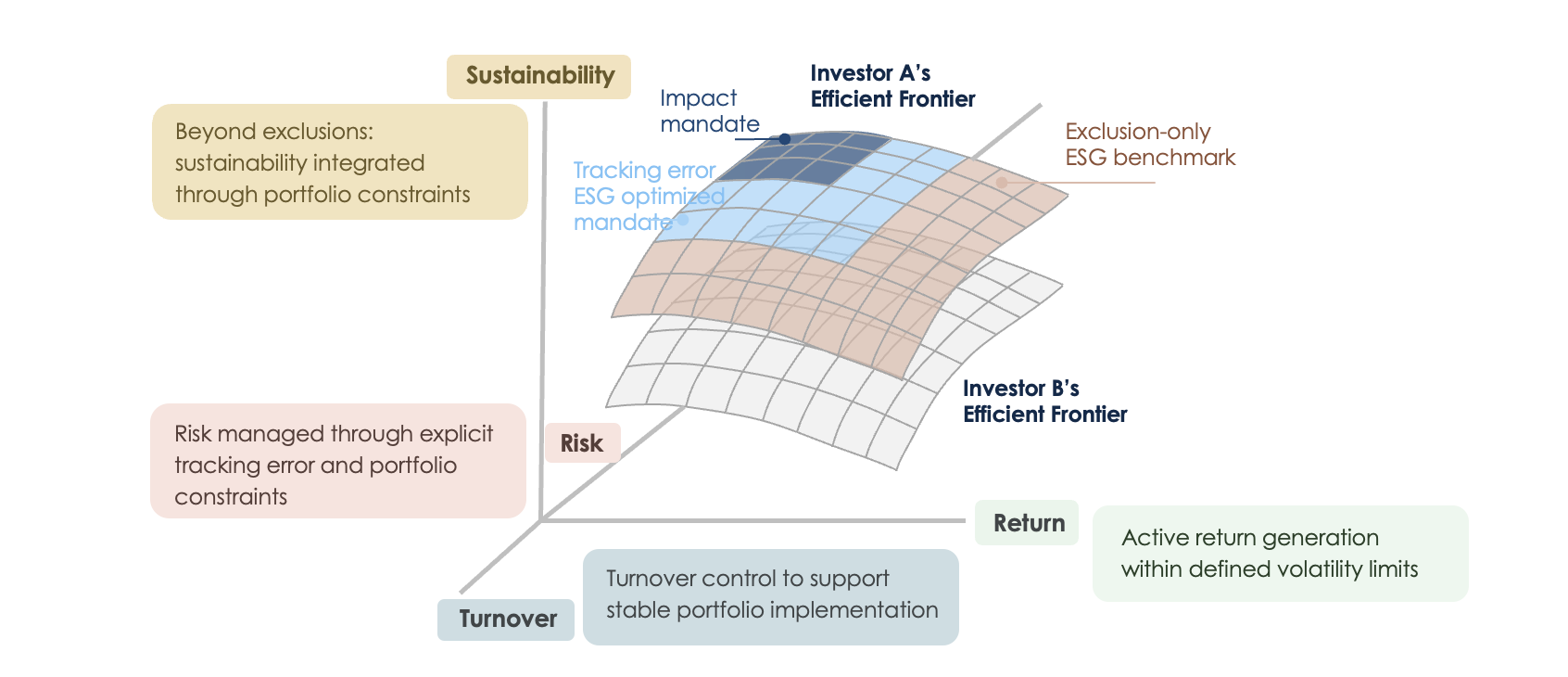
The rules of investing have adapted to new investment requirements, and to modern optimization possibilities across multiple and simultaneous dimensions — not just risk and return.
If the relationship between a portfolio’s risk and return has been described as ‘2D investing,’ and the addition of sustainability parameters has led in recent years to ‘3D investing,’ a ‘4D’ approach is one that incorporates a fourth lens: that of turnover discipline to control for trading costs, explained Rodney Fernandes of STOXX.
“For many pension funds — especially where cost transparency is critical — turnover is not ‘free,’” said Fernandes, Head of Buy-Side Index Sales for UK & Ireland, EMEA and Nordics. “In ‘4D,’ we aim to trade only when it improves risk, return, or sustainability enough to justify the transaction costs.”
Figure 1: 4D investing
Practical 4D investing application in emerging markets
APG calls this ‘4D’ approach ‘Diamond Investing,’ said Hans van Westrienen, Team Lead for Quant & Index Solutions at APG Asset Management, who shared the panel with Fernandes. In his words, ‘4D’ indices balance trade-offs to deliver resilient investment outcomes, including liquidity and a transparent methodology that is easy to understand.
Van Westrienen explained how these dimensions have been integrated into the new Emerging Market Equity index designed by APG and STOXX to become “conscious decisions” in its construction process.
The Emerging Market Equity index’s starting universe is the emerging markets space within the STOXX Investable Market Indices (‘STOXX IMI indices’) a new suite that provides broad, global equity coverage through a consistent and modular index framework.
Designed based on asset manager and asset owner feedback, the index suite offers 99% coverage of the global investable equity universe across 23 developed and 23 emerging markets and all cap sizes. The STOXX IMI indices were conceived as representative, tradable and scalable tools, and based on a building-block architecture for optimized strategies.
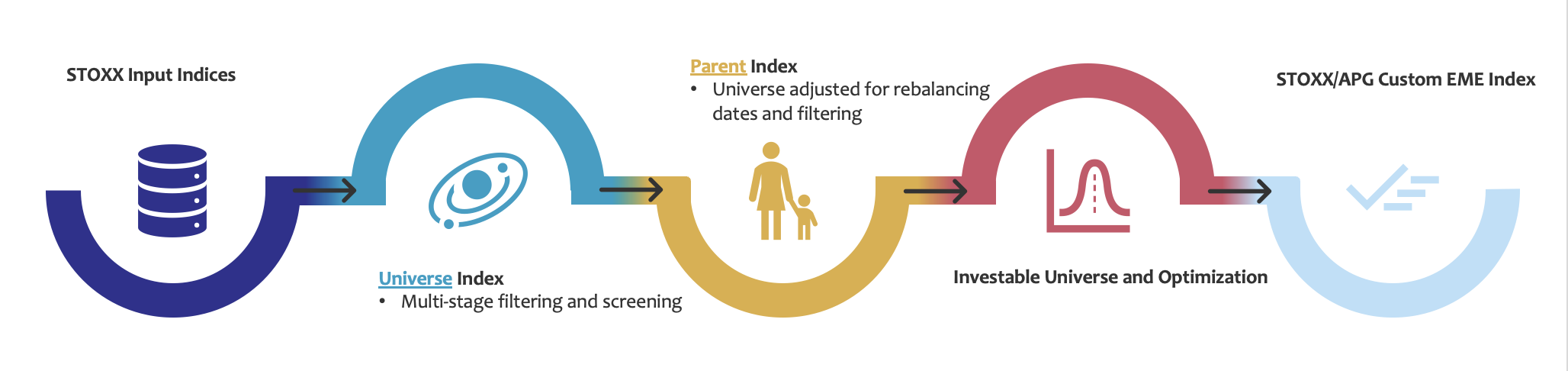
The Emerging Market Equity index construction begins by narrowing the broad emerging-market input universe (stage 1) into a more representative and investable selection, Van Westrienen explained. Companies are screened for accessibility, meaningful size and sufficient liquidity, resulting in a refined universe index (stage 2) focused on large- and mid-cap companies that meet investability standards.
This universe is refined further into a parent index (stage 3) by adjusting the rebalancing to periods that better align with internal flows and higher market liquidity. This reduces transaction costs and improves real-world implementation, key considerations for long-term index investors, Van Westrienen said.
From the parent index, index construction moves into the final stage, where responsible investing and optimization become central. Filters are applied so that only companies meeting APG’s sustainability criteria remain. Optimization is then used to shape the final, custom index (stage 4) according to a defined set of constraints — not to maximize returns, but to balance the four elements in APG’s Diamond Investing framework while maintaining close alignment with the parent index’s exposure and carefully managing risk.
Figure 2: Four steps to the STOXX/APG custom Emerging Markets Equity index
“The index is a tool that integrates our investment beliefs and balances, and throughout the process deals with the inherent multiple trade-offs,” said Van Westrienen. “Those include the trade‑off between responsible investing and broad market exposure, the one between purity and investability, and that between complexity and explainability.”
The result is an index that is resilient for a EUR 20 billion portfolio managed by APG.
“For us, index investing is not about being passive — it’s about making conscious choices,” said Van Westrienen, “and being explicit about our objectives and the trade‑offs. This approach supports the participants in offering a stable and affordable pension for the millions of people who depend on us for their retirement benefits.”
Sophistication and evolution
Index investing continues to evolve, responding to the growing needs of investors and the increasing sophistication of available data and analysis. Throughout this evolution, the core principles of a systematic, rules-based methodology — one that remains transparent and easy to understand — must be preserved. The 2026 SimCorp Global Summit offered an excellent opportunity to hear first-hand one of the latest examples of this progress in action.
Next year’s Summit is sure to bring further compelling insights for the buy-side and other financial-market participants.
[1] APG is the largest pension provider in the Netherlands, where it looks after 4.6 million people.