
Celebrated each May 9, Europe Day is a fitting moment to take stock of the STOXX® Europe 600 index — which continues to attract flows and new investment products as the benchmark for an entire continent.
Nearly EUR 17 billion in mutual fund investments[1] and more than EUR 30 billion in passive ETF assets[2] are currently benchmarked to the index, which provides a broad yet investable representation of the region’s developed markets. Amid increasing interest in European equities, passive ETFs tracking the benchmark lifted their assets by 58% last year. The momentum has carried on into 2026, with total assets under management rising another 6.5% in the first quarter to EUR 32.5 billion.
Trading in futures and options tracking the STOXX Europe 600 and its subsets jumped 16.5% last year to nearly 53 million contracts, while open interest notional value rose 26.2% to EUR 57.4 billion.
“An effective benchmark isn’t just measured — it’s traded,” said Serkan Batir, Global Head of Product Development at STOXX. “While tradability reflects investor adoption, ultimately the driver behind both is a benchmark’s representativity, objectivity and transparency.”
Increased product availability
Meanwhile, new products have added to the ecosystem of strategies built around the benchmark, expanding the set of trading possibilities on European equities. BlackRock’s iShares is introducing a new, Ireland-domiciled ETF linked to the index. It follows the launch of iShares ETFs on the STOXX® Europe 600 Top 20 last December, and on the STOXX® Europe 600 Domestic Focus and STOXX® Europe 600 Foreign Focus indices this year, which segment the continent’s companies by geographic revenue exposure.
Those products complement existing STOXX Europe 600 ETFs managed by Amundi, BNP Paribas, DWS and Invesco, as well as another ETF from iShares listed in Germany.
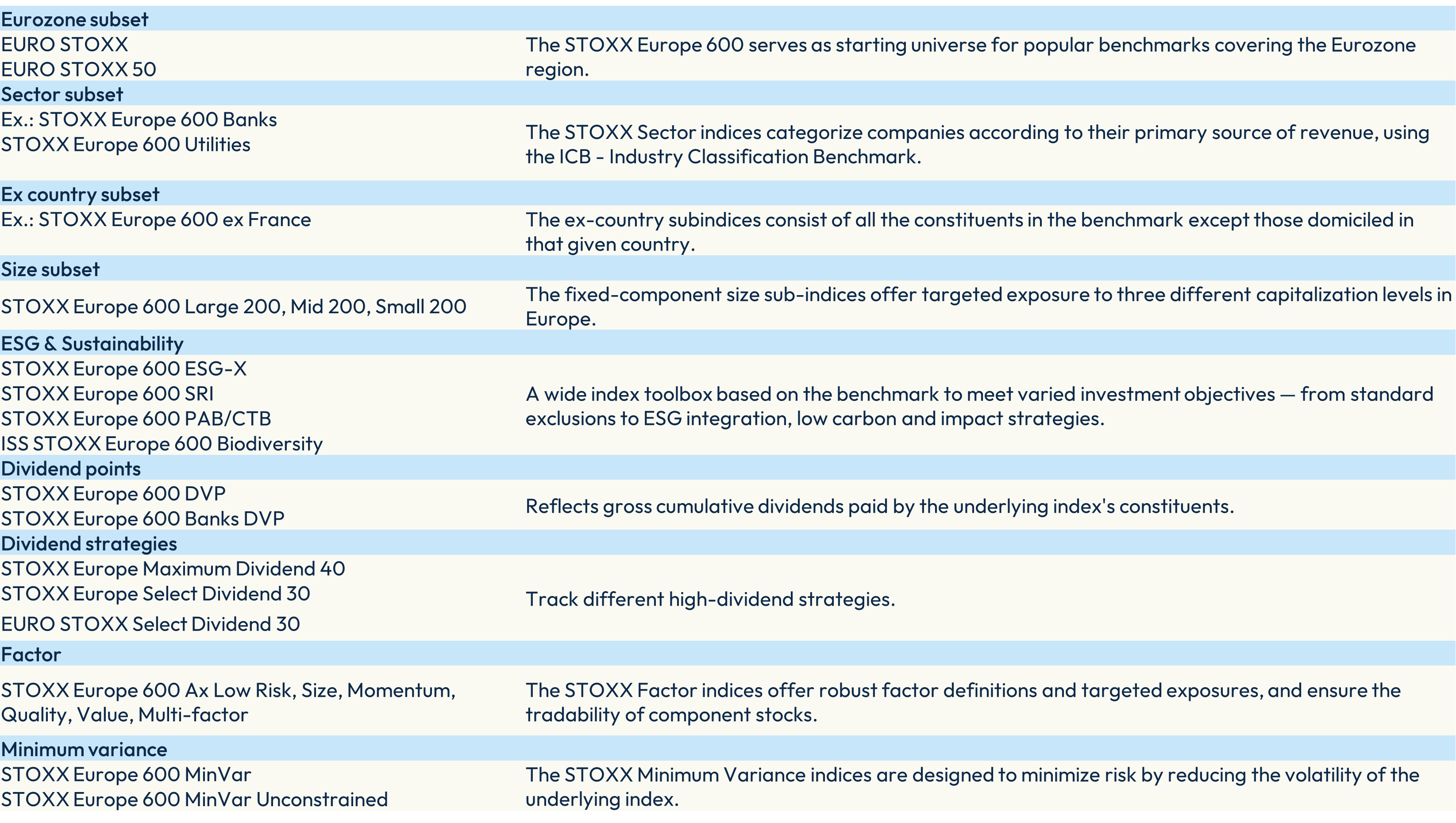
On the derivatives side, Eurex introduced weekly options and total return futures on the index in 2024. Europe’s largest derivatives exchange offers products on STOXX Europe 600 Supersector, sustainability and size strategies to meet investor demand for hedging and managing portfolio flows and positions. These and several other sub-indices derived from the STOXX Europe 600 form a truly versatile family (Figure 1).
Figure 1: STOXX Europe 600 family
Methodology
The STOXX Europe 600 is derived from the STOXX® Europe Total Market index (TMI) and is a subset of the STOXX® Global 1800. With a fixed number of 600 components, the benchmark represents large-, mid- and small-capitalization companies across 17 countries,[3] — the widest coverage among flagship European benchmarks in the industry in terms of market capitalization and number of components.[4]
A liquidity filter[5] supports the tradability of the index’s portfolio, while a quarterly review based on clear rules gives it a continuous pulse on market changes. Buffer rules ensure a moderate turnover at each review.
Investable exposure
Because of its transparent and rules-based construction methodology, the STOXX Europe 600 has become a favorite for asset managers and issuers since its launch in June 1998 by providing investable exposure to the region. In particular, overseas investors have used the index to diversify global portfolios.
As the nature of index-based investing continues to change, benchmarks are now used as a toolbox for building customized strategies. The family of indices derived from the STOXX Europe 600 and the trading vehicles around it will continue to grow as STOXX caters to the increasingly tailored needs of investors.
Related articles
European benchmarks – the STOXX ecosystem
Q&A with Eurex’s Stuart Heath: STOXX Europe 600 total return futures
New STOXX Europe 600 SRI futures on Eurex broaden sustainable derivatives offering for investors
Taking stock of the STOXX Europe 600’s record-breaking rally and its FX-hedged versions
[1] Source: Morningstar.
[2] Source: STOXX.
[3] Austria, Belgium, Denmark, Finland, France, Germany, Ireland, Italy, Luxembourg, the Netherlands, Norway, Poland, Portugal, Spain, Sweden, Switzerland and the United Kingdom.
[4] Based on index market capitalization.
[5] Stocks must have a minimum liquidity of greater than EUR 1 million measured over the 3-month average daily trading volume (ADTV).