
Ten years ago, STOXX and BlackRock began a collaboration in index-based thematic investing with the launch of four iShares ETFs, giving investors a systematic way to gain exposure to some of the long-term structural changes reshaping economies and societies.
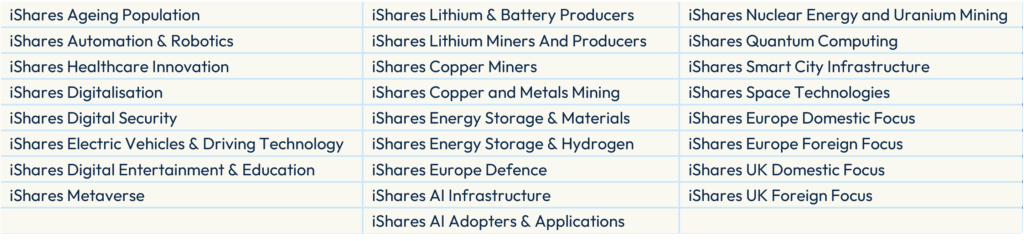
The funds, launched on September 8, 2016, tracked STOXX indices targeting four themes: aging population, automation and robotics, breakthrough healthcare and digitalization. A decade later, the partnership between STOXX and BlackRock has grown to include 25 thematic ETFs spanning the three big megatrends of Future Technology, Socio-demographics and Environment. Total assets under management stood at EUR 12.4 billion at the end of July 2026.[1]
The expansion has come during a decade in which thematic investing has grown in prominence as investors seek sources of diversified returns in a fast-changing technological and social world, and demand more sophisticated ways to pursue them. The underlying indices for the 25 ETFs have posted an average annualized return of 15% in euros, based on available data going back as far as 2016.[2] That compares with a 12% annualized return for the STOXX® World AC benchmark over the period.
Figure 1: iShares thematic ETFs tracking STOXX indices
Evolution in index-based investing
But the past decade has brought more than new themes and investment products. It has also transformed the way those themes can be recognized and translated into an index.
Over ten years, STOXX and BlackRock have navigated that evolution together, incorporating new research, datasets and technology into index construction.
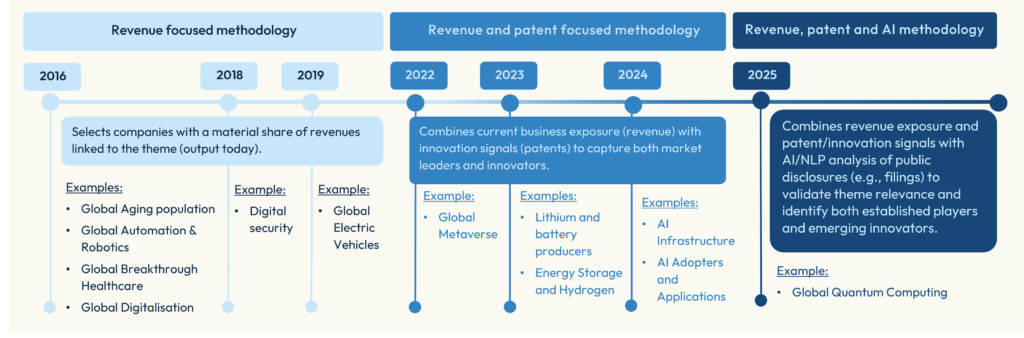
What started with a methodology centered on companies’ revenue exposure has expanded to incorporate patents as a forward-looking measure of innovation and, most recently, artificial intelligence (AI) and natural-language processing (NLP) to capture unstructured data.
Revenues as starting point
The first four indices developed for iShares in 2016 used a revenue-focused methodology to identify companies with material business exposure to each targeted theme.
This approach addressed one of the fundamental challenges in thematic investing. Themes rarely fit neatly within traditional sector classifications. Automation, for example, can encompass companies across Technology, Industrials and other sectors, while an aging population theme can create opportunities in industries ranging from Healthcare to Financial Services.
Revenue data provided a way to look across those traditional boundaries and pinpoint companies whose businesses were already participating in a structural trend. STOXX has most often used FactSet’s Revere (RBICS) granular data to break down companies’ sources of sales and determine their exposure to activities associated with a theme.
As new economic and technological trends became evident and investable, new iShares ETFs tracking STOXX thematic indices were introduced. They included those covering digital security and electric vehicles.
Looking ahead with patents
By the start of this decade, another question had become increasingly important: in a fast-changing world, how can an index capture not only the companies generating revenues from a theme today, but also those developing the technologies that may shape it tomorrow?
Patents offered one answer.
Beginning in 2022, STOXX and BlackRock incorporated patent data into their thematic work. The analysis of a company’s efforts in intellectual property can provide an early indication of where they are directing research and development, helping find innovators before a new technology translates into significant revenues. STOXX has worked with EconSight, a leading analytics provider specializing in patent research.
The STOXX® Global Metaverse was among the first to combine current business exposure with patent signals. The methodology was subsequently applied to themes including lithium and battery producers, and energy storage and hydrogen.
The approach complements, rather than replaces, revenue analysis. The combination of both signals is particularly relevant in nascent technologies and resources, whose development can unfold over many years.
The AI era
In the most recent years, the rise of AI has opened another chapter in both thematic investing and index construction, further influencing the STOXX-BlackRock collaboration in two ways.
First, AI became an investment theme in itself.
In 2024, BlackRock and STOXX unveiled indices targeting two distinct parts of the AI ecosystem: The STOXX® Global AI Infrastructure, tracking providers of the computing power, semiconductors and other building blocks behind AI; and the STOXX® Global AI Adopters and Applications index, which selects companies employing the technology to enhance products, services and operations. Both indices combine revenue and patent information to pick constituents.
But AI has also become a tool for assessing thematic exposure, and this methodological step came with the theme of quantum computing in 2025. Here, the STOXX® Global Quantum Computing index added AI and NLP analysis of publicly available company disclosures, including regulatory filings, to patent signals. This unique, multi-focus process was a first for STOXX and it helped validate companies’ relevance to a theme that is rapidly growing
“Thematic investing is about identifying the structural forces that are reshaping economies, industries and consumer behaviour, and translating them into investable opportunities,” said Omar Moufti, Thematic, Sectors, Factors & Commodities Product Strategist at BlackRock. “Our collaboration with STOXX has been built around that evolution, combining research, data and technology to help investors gain exposure to the long-term forces transforming the global economy.”
“Behind every successful index strategy is a strong partnership,” said Ladi Williams, Head of Thematics & Alternative Strategies, Product Management, at STOXX. “The relationship between STOXX and BlackRock has been defined by open collaboration, mutual trust and a shared focus on delivering solutions that meet clients’ evolving needs.”
Figure 2: Evolution of STOXX thematic index methodologies
Identifying an investable theme
Yet before deciding which tools are best suited to harness a theme, an earlier question must be answered: is the theme itself sufficiently developed to be investable?
STOXX uses a lifecycle framework to evaluate potential investable themes based on their conceptual and business progression. This framework draws from the diffusion of innovations theory[3], which attempts to explain how a specific technology or idea permeates within a society.
The framework recognizes four stages in the development of a theme: ideation, innovation, commercialization and maturity. As it moves through the cycle, conviction grows from low to high. Thematic investing uses indicators to identify companies that, at each stage, are most likely to be the main contributors to or beneficiaries of the trend.
“The validation of a theme starts when it is first conceptualized and continues all the way through to index construction,” said STOXX’s Williams. “The research, filters and constraints we apply ultimately determine the right portfolio for each client.”
A decade of change
STOXX also celebrated another milestone this year: the 15th anniversary of its Thematics index offering. Since the suite was introduced in 2011, the range of topics accessible through rules-based indices has expanded significantly.
For investors, this has opened possibilities as themes continue to transform. New technologies emerge, industries converge and companies change the markets they serve. Some themes eventually mature into established sectors. The methods used to define thematic exposure must adapt alongside them.
The evolution is unlikely to stop here. STOXX and BlackRock remain focused on what comes next. As technological change accelerates and the investment landscape continues to evolve, both firms are committed to advancing the way themes are identified, measured and translated into portfolios. With a robust pipeline of new ideas and innovations under evaluation, the next chapter of thematic investing is already taking shape.
[1] Source: STOXX. Data as of July 31, 2026.
[2] Source: STOXX. Gross returns in EUR, using a geometric-mean compound annual growth rate. Not all indices have data going back to 2016.
[3] The diffusion of innovations is a theory by Professor Everett Rogers.