
This year marks an important milestone for STOXX: 15 years of thematic indexing. Since 2011, STOXX has built a comprehensive suite of thematic indices designed to provide access to long-term and disruptive forces across three broad categories — environmental, technological and socio-demographic megatrends — that are reshaping our world.
Identifying a powerful theme is only one part of thematic investing. Equally important is understanding where that theme sits in its development journey. Themes emerge, mature and eventually become widely adopted, outlining a lifecycle that will determine the opportunity set.
To address this, STOXX developed a Thematic Framework that helps classify, capture and navigate investment themes according to their stage of development.
Investing along the theme lifecycle
Not all themes are alike. Some are at the forefront of innovation, driven by breakthrough technologies — but have yet to enter the commercialization stage. Others are already generating meaningful revenues across a growing cohort of companies. Some have reached widespread adoption, and the investment opportunity extends well beyond the original innovators and into new sub-themes.
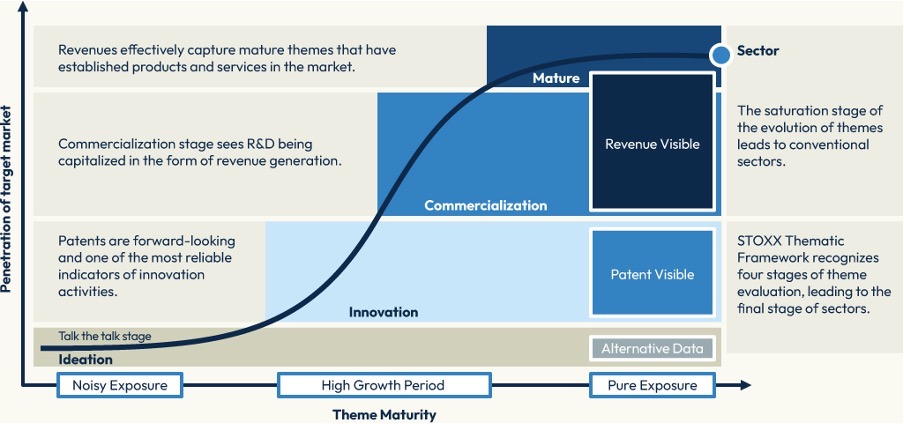
The STOXX Thematic Framework reflects this progression through a lifecycle approach that maps the conceptual and business evolution of a theme, distinguishing four stages of development: ideation, innovation, commercialization and maturity (Fig. 1). This progression is based on the Diffusion of Innovations theory by Professor Everett Rogers.
Figure 1: STOXX Thematic Framework – Mapping a theme’s evolution
Finding the right signal and approach
“This framework recognizes that a theme is not static,” said Ladi Williams, Head of Thematics and Alternative Strategies at STOXX. “Rather, it evolves through time, creating distinct opportunities and requiring different signals and methods of stock selection to identify the theme’s contributors or beneficiaries. Knowing when and how to invest in a theme is crucial for an effective strategy.”
At the earliest stage, innovation-focused themes seek to identify companies developing the technologies that may shape future industries. These strategies often rely on forward-looking signals, such as patent activity. STOXX has worked with EconSight, whose patent data is used to identify innovators in a set of technologies linked to each theme.
As themes progress toward commercialization, revenues become increasingly relevant in identifying companies benefiting from growing adoption.
Finally, as themes mature and become embedded across industries and value chains, investors may seek exposure to a broader ecosystem of beneficiaries, including infrastructure providers, suppliers, enablers and adopters.
“The adoption curve also reflects the profile of a theme in terms of risk and reward, with the earliest stages offering the biggest potential returns but also the highest volatility,” added Williams. “The ‘sweet spot’ may be at the steep part of the curve between innovation and commercialization.”
Sometimes a combination of selection techniques and multiple data sources is needed, responding to the specific characteristics of each theme and its stage of development. All these criteria can be embedded into indices in a low-cost, transparent and systematic manner.
As new themes emerge and others evolve, the framework creates a dynamic landscape in which innovation and adoption coexist, often across the same megatrend.
Digging into sub-themes
Artificial intelligence provides a clear example. What began as a largely research-driven field has evolved into a broad universe that encompasses innovators advancing AI capabilities, those deploying the needed infrastructure, or the businesses adopting AI to transform their operations.
To target those distinct segments, STOXX has developed a suite of AI-focused indices:
- STOXX® Global Artificial Intelligence
- STOXX® World AC AI Market Leaders
- STOXX® Global AI Infrastructure
- STOXX® Global Artificial Intelligence Innovators
- STOXX® Global AI Adopters and Applications
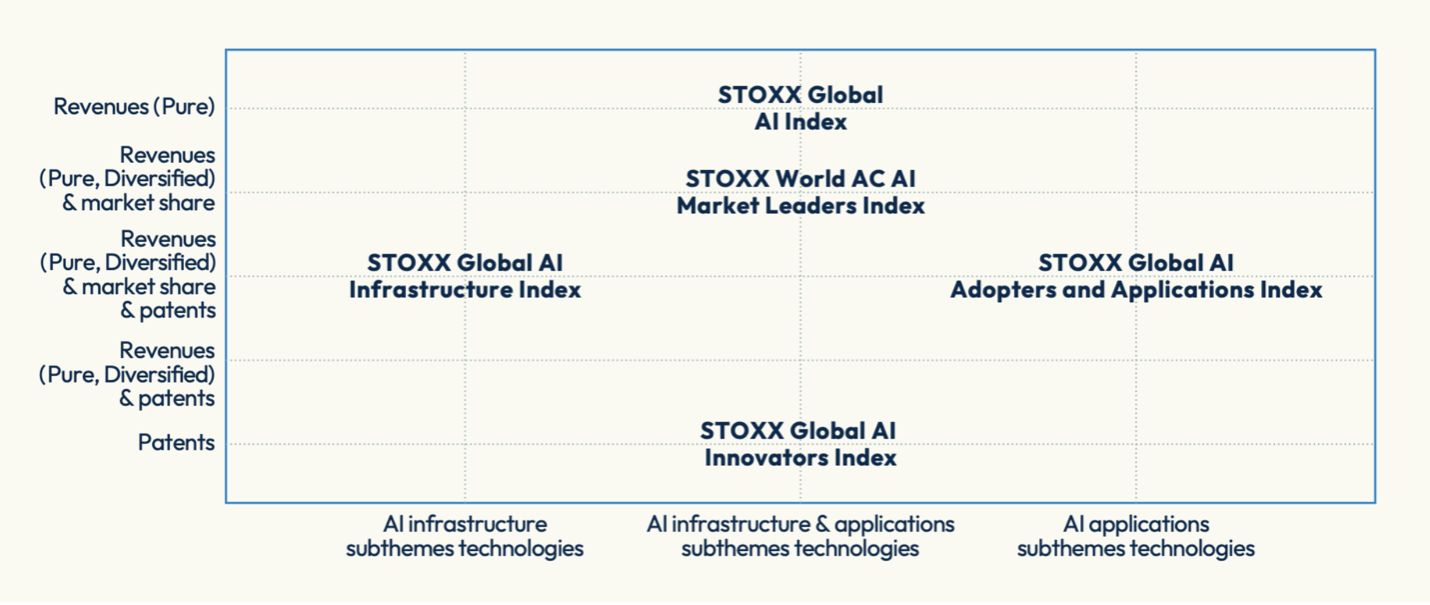
These indices also exemplify how methodologies can be customized to capture specific types of companies, such as Pure Players, Diversified Players and Innovators (Fig. 2). This strikes a flexible balance between purity of exposure and higher-growth opportunities. Market share is also another useful metric that is used to identify Market Leaders.
Figure 2: STOXX AI index suite – composition profile
The next frontier: expanding opportunities through AI
The future of thematic investing is likely to be shaped not only by emerging megatrends but also by advances in the technologies used to identify them.
Artificial intelligence is increasingly enabling the analysis of vast quantities of unstructured information, including company disclosures, analysts’ research and corporate websites. These capabilities can help uncover thematic exposures that may be difficult to identify through traditional classification systems.
The recently launched STOXX® Global Quantum Computing index illustrates this evolution. Quantum computing remains at an early stage of commercial development, making conventional revenue-based identification challenging. The STOXX index combines patent exposure and AI text analysis of companies’ annual reports and corporate websites to select companies with the highest exposure to the targeted theme.
Advancing AI technologies may yield new data sources, more sophisticated analytics and improved thematic classification techniques, allowing investors to access emerging opportunities earlier and with greater precision.
Looking ahead
The thematic landscape today is broader and more dynamic than ever, spanning transformative technologies, environmental challenges and demographic shifts. Fifteen years after the launch of its first thematic index, STOXX continues to refine the tools investors use to navigate structural change. Yet the core objective remains unchanged: offering investors transparent, rules-based exposure to the companies benefiting from long-term megatrends.
The STOXX Thematic Framework provides a lens through which investors can understand not only what a theme is, but also where it sits in its journey from innovation to adoption. As new themes take shape, that lifecycle perspective will remain central to capturing the possibilities they offer.
Further reading:
Thematic indices: Capturing trends from AI to defense to transition metals