
This month, STOXX® announced changes to the rules governing the EURO STOXX 50®, the Eurozone’s flagship equity benchmark.
Following a market consultation between July and September, STOXX approved three changes:
- Aligning fast exits with regular index changes: From the September 2027 review, fast exits — removals triggered by a sufficient decline in a constituent’s selection-list ranking — occurring in March, June, September or December will take effect at the close of the third Friday of the month. Aligning these exits with regular reviews and rebalances aims to reduce unnecessary turnover and operational burden for index trackers.
- Introducing semi-annual reviews: March and September reviews[1] will replace the annual September review. The rule takes effect with the September 2028 review.
- Removing Supersector capping: From the September 2029 review, the Supersector capping rule used in stock selection since the index’s 1998 inception will be removed.
Currently, stocks within each EURO STOXX® Supersector index are ranked by free-float market capitalization. The largest enter the selection list until their combined capitalization is as close as possible to 60% of the corresponding EURO STOXX® Total Market Index Supersector index. All existing EURO STOXX 50 constituents are also included.
Under the revised methodology, all eligible stocks will enter the selection list, ranked by free-float market capitalization regardless of Supersector. The existing buffer remains: the top 40 stocks are selected first, with the remaining ten places filled by the highest-ranked existing constituents in positions 41–60. The changes aim to better reflect underlying market trends and improve transparency and simplicity.
Impact on composition
For investors tracking the index or using it as a benchmark, they will want to understand how the changes affect their portfolios, performance and turnover. STOXX analyzed backtested data to estimate that potential impact. Backtests have inherent biases and flaws, so the results are no guarantee of future performance.
Figure 1 shows the allocation to 16 ICB Supersectors and to national markets of the current EURO STOXX 50 and of the new index version that includes all three upcoming methodology changes.
Figure 1: Supersector and country allocation
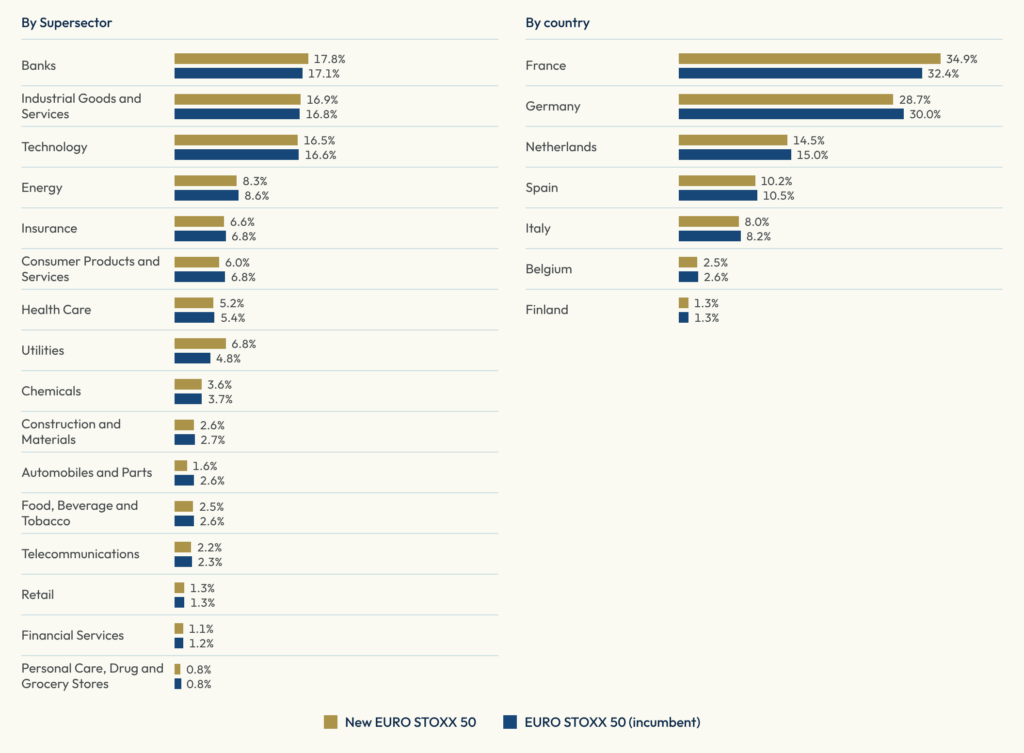
The chart shows no major change in the allocations between the incumbent EURO STOXX 50 and a recreated new EURO STOXX 50. The biggest difference in Supersectors is a 2.1 percentage-point weight increase to Utilities, while a 2.5 percentage-point additional exposure to France in the new EURO STOXX 50 version is the largest deviation in country allocations.
Risk and return
The analysis in Figure 2 similarly shows that there are only marginal differences in various risk and return metrics.
The table here shows four portfolios to understand the effect of each one of the two main changes — the scrapping of the Supersector cap (first column) and the introduction of a semi-annual review (second column). The fast-exit change is not modeled. The third column shows the historical replication of the new index with both key methodology changes. The fourth column shows the incumbent EURO STOXX 50.
Figure 2: Risk and return characteristics
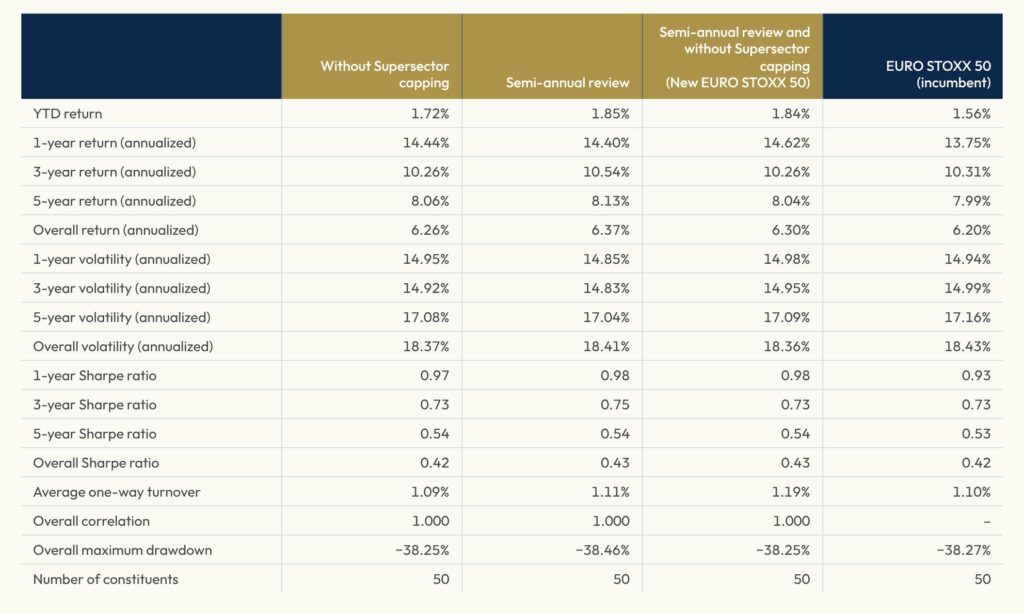
In backtested data between September 25, 2012, and April 30, 2026, the four index versions show an annualized performance that ranges between 6.20% and 6.37% — a maximum difference of only 17 basis points a year. The full new methodology returned 6.30% a year, while the incumbent grew 6.20%, the lowest return.
The overall annualized volatility also changes within a tight range: from 18.36% to 18.43%. Sharpe ratios and maximum drawdowns are very similar for all four portfolios.
Average yearly one-way turnover rises slightly between the new and current index versions, to 1.19% from 1.10%, a result of not constraining for Supersector exposure and of implementing two reviews a year.
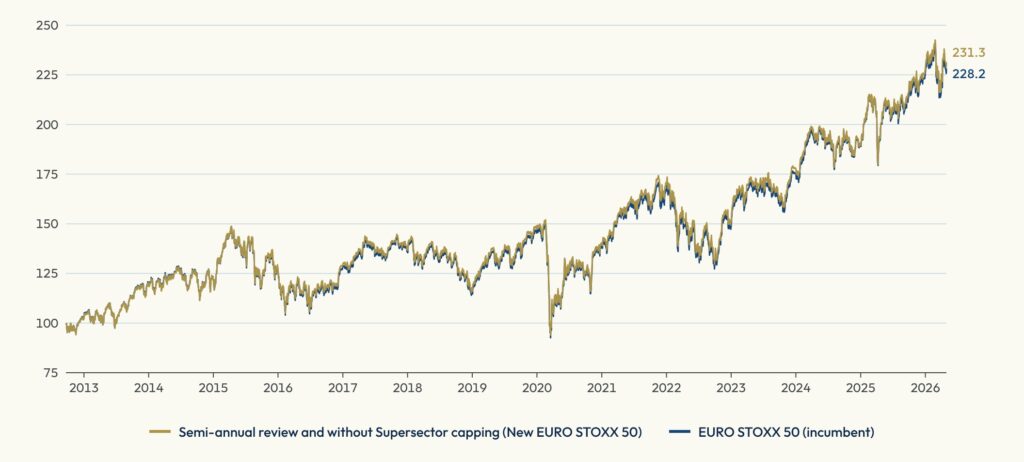
Figure 3 shows the backtested performance of the existing and new EURO STOXX 50 versions. Since September 21, 2012, the new index would have outperformed the existing benchmark by about 3 percentage points.
Figure 3: Performance
Improved representativeness of underlying market trends
“These changes make sure the EURO STOXX 50 keeps pace with the Eurozone’s equity market, reflecting the companies that lead it today and adapting faster,” said Sahand Taghizadeh, Head of Investable Benchmarks at STOXX. “For the many investors and product providers who track the index, continuity matters as much as evolution. Our analysis shows the new rules achieve both: a more representative benchmark with minimal disruption to composition, risk and returns.”
The EURO STOXX 50 is one of the world’s most tracked benchmarks, with nearly EUR 60 billion invested in ETFs tracking it. More than 320 million futures and options on the index changed hands on Eurex in the first nine months of 2026.
Full details of the methodology changes and the consultation results are available in an index announcement.
[1] The March and September reviews use selection data as of the last trading day of February and August, respectively.