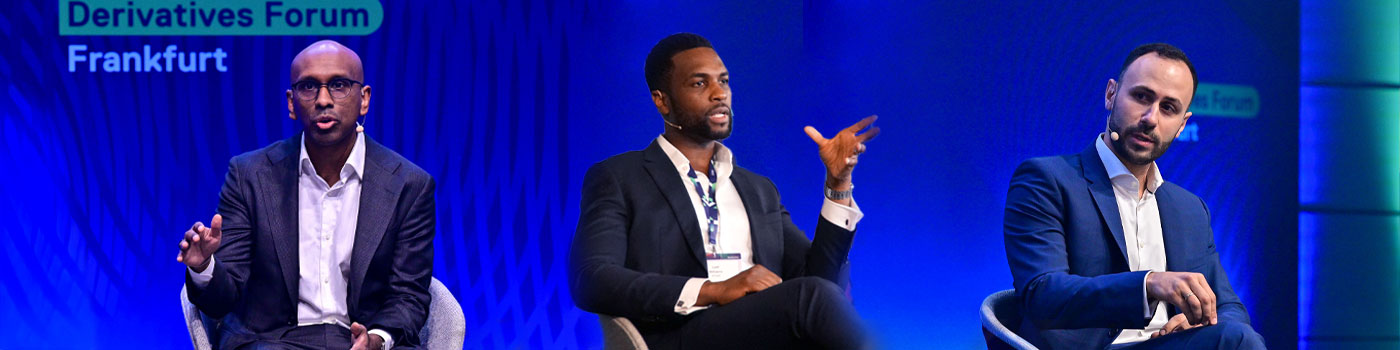
Four panels at the recent Eurex Derivatives Forum in Frankfurt offered a platform for STOXX experts to discuss key trends in the listed derivatives market — from volatility strategies and buffer ETFs to thematic portfolios.
One panel explored how ETF derivatives and buffer ETFs are used to implement overlays that enhance portfolio efficiency, manage downside risk and optimize capital.
Hamish Seegopaul, Global Head of Index Product Innovation at STOXX, said there are two buckets of demand in defined-outcome strategies: income and buffer portfolios. While the former has seen strong uptake as traders sell upside exposure to generate income, the latter has lagged somewhat, he said. The slow uptake in buffer strategies may reflect the ongoing bull market since 2023, Seegopaul added.
“The entire concept of buffers is a study in the trade-off between protection and how much upside you sell, and the trade-off between short-term certainty and long-term gain,” Seegopaul said. A whitepaper published last year by STOXX found that the short-term certainty offered by buffer strategies does not compensate for forgone gains in the long run.
While buffer ETFs and options overlays have grown rapidly in the US, Europe-based clients have favored similar payoff profiles delivered through structured products and index-based formats.
“You have to be very clear about what the investment objective is,” Seegopaul said. “For near-term protection, these buffer strategies are terrific; for buy-and-hold, long-term, permanent exposure, you may need to think about different strategies.”
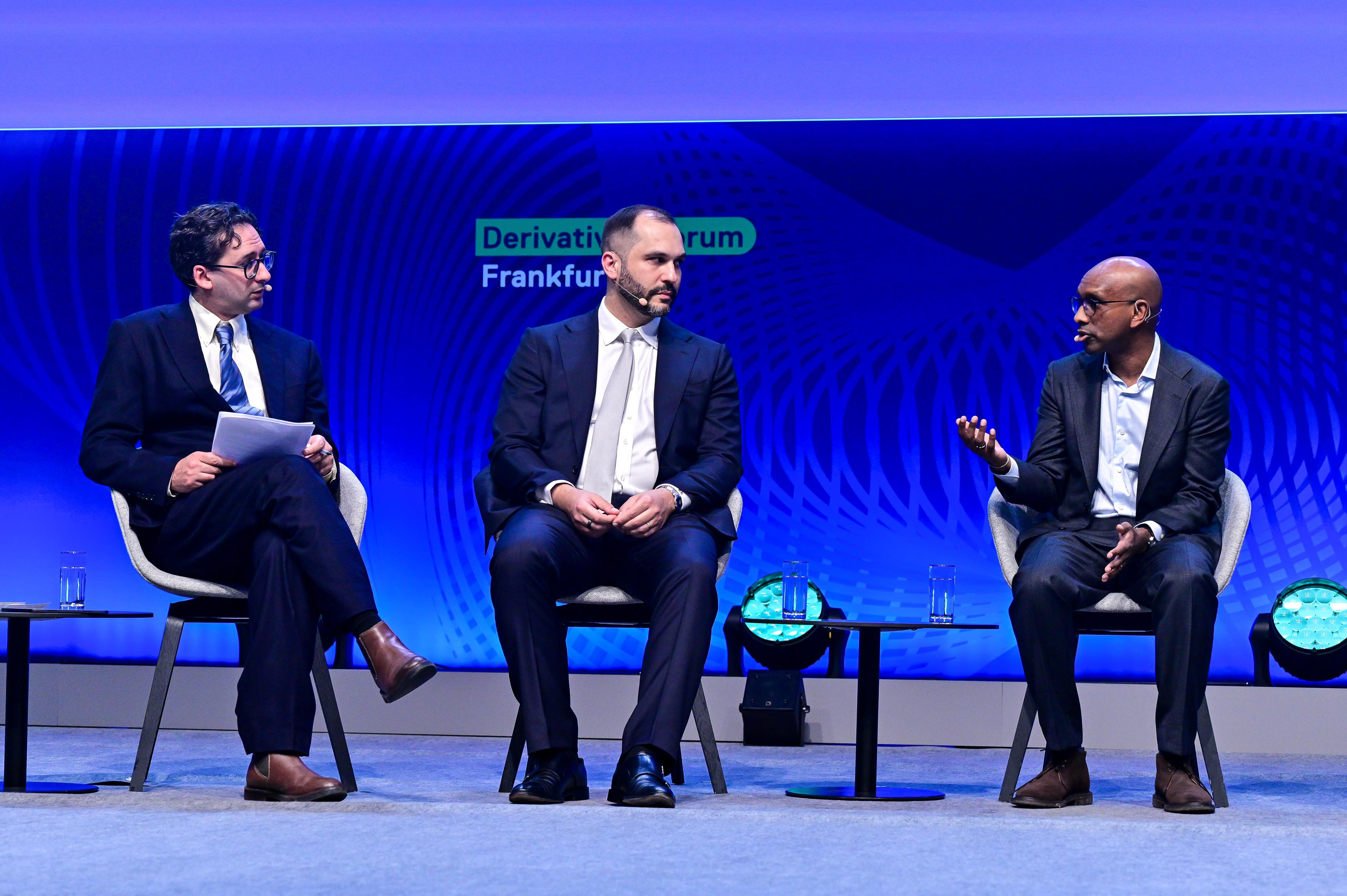
The panel also underscored other benefits of buffer ETFs. Speaking at the same session, Sushil Krishan, Managing Director at Goldman Sachs, said the strategies offer investors a “super interesting” yield enhancement on traditional equity holdings.
Volatility strategies
Speaking at a panel entitled “Volatility in Motion – Cross-Asset Innovation and Strategy from a Buy-Side Lens,” Sahand Taghizadeh, Head of Investable STOXX Benchmarks, noted that one particularly strong area of demand has been indexed volatility strategies.
“Clients are looking at risk-control or volatility-targeting indices and trying to achieve either lower or higher volatility targets depending on the exposure they seek,” he said.
Imanol Urquizu, Head of Derivatives, Santander Asset Management, said that two decades ago traders would buy derivatives solely as portfolio protection. However, these days “people are seeking derivatives also to generate income, to generate alpha through relative value.”
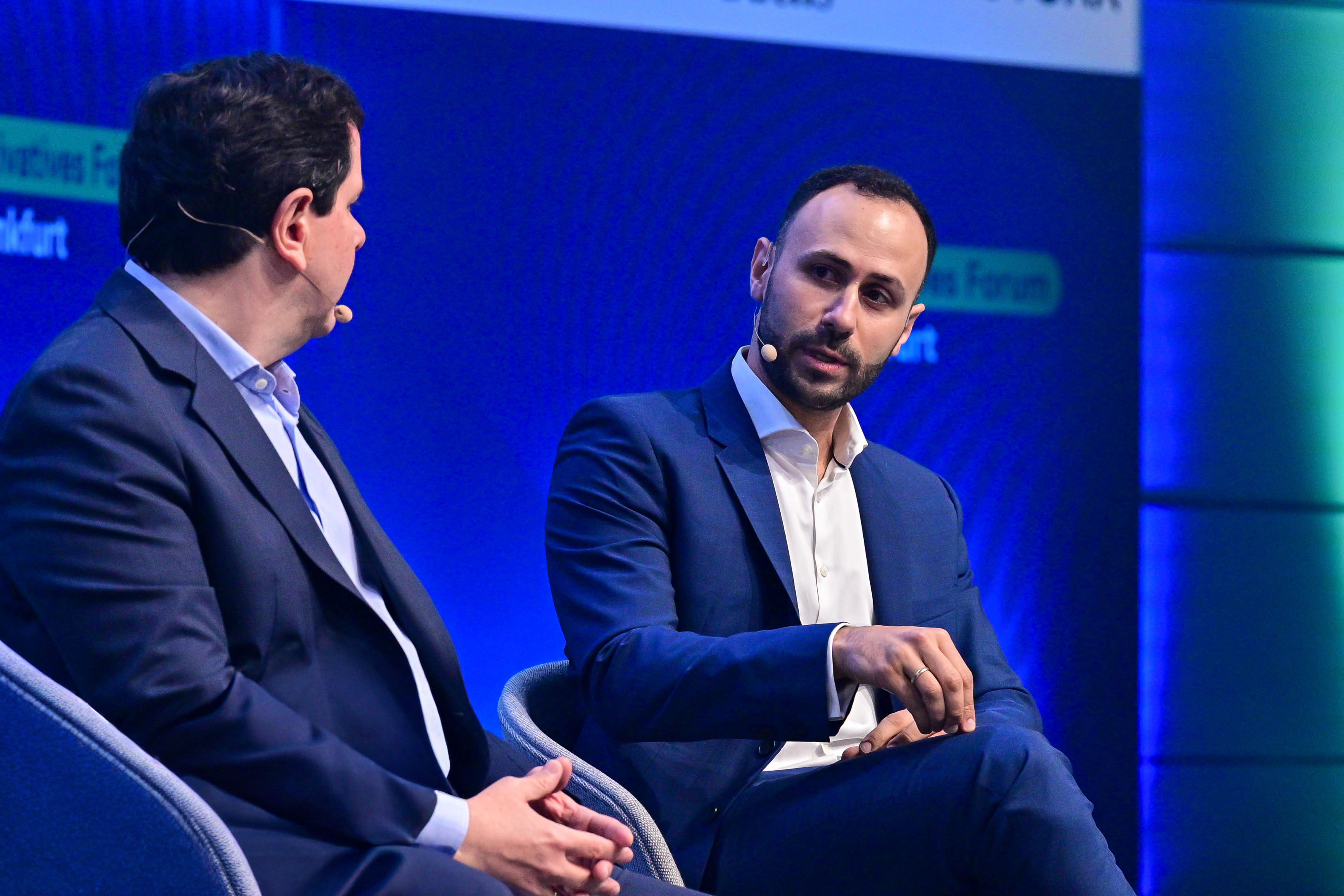
One of the strongest messages from Taghizadeh at STOXX was that volatility products cannot succeed in isolation. To support and grow volatility as an asset class, he said, “you need an ecosystem.”
That ecosystem consists not only of liquidity but also of complementary tools: daily options, weekly maturities, monthly contracts and hedging instruments on equities and ETFs that allow market participants to isolate specific risks with precision, without leaving unintended exposures.
The appeal is clear: investors seek smoother return paths or managed exposures amid episodic volatility spikes and macro uncertainty. Trading volatility as an asset class in itself has provided a way to do just that. In 2025, nearly 16 million futures and options on VSTOXX® — the EURO STOXX 50 Volatility index — exchanged hands on Eurex.
A consensus among panelists was that the availability of listed options on ETFs across asset classes has significantly increased the possibilities for market participants, while helping the liquidity in the ETFs themselves.
QIS, dispersion
Across the panels, speakers pointed to the ongoing migration from over-the-counter (OTC) structures to listed formats — or futurization — a trend driven by margin optimization, transparency requirements and improved on-screen liquidity.
Sophie Granchi, Regional Sales Manager at Eurex, said that 20 years ago, listed and centrally cleared contracts accounted for around 40% of the derivatives trading volume she executed for clients. Today, that figure is closer to 80% or 90%, she added. One example of such evolution is the market for total return futures, she said.
At the same time, the rise of systematic strategies — including quantitative investment solutions (QIS) — is reinforcing the need for robust benchmark infrastructure and reliable pricing.
Although headline index volatility has remained broadly contained, Alexandre Capez, Head of Equity Derivatives Trading for EMEA at HSBC, noted during a discussion that dispersion beneath the surface has been significant. This divergence reinforces the importance of having multiple volatility instruments across maturities and underlyings.
Thematics: specialization, concentration, datasets
On a separate panel on thematic investing, Ladi Williams, Head of Thematics and Alternative Strategies at STOXX, reflected on how the thematic ETF industry has evolved over the past decade and a half. The discussion was timely as nearly EUR 62 billion flowed into thematic ETFs worldwide in 2025, more than ten times the amount a year earlier.

STOXX is marking 15 years of its thematic index offering in 2026, and Williams noted that two visible shifts have occurred over that period: the move toward greater specialization and portfolio concentration. Early thematic portfolios often contained several hundred constituents. Today, exposure has become significantly more targeted, with many strategies holding just a couple of dozen stocks.
“Themes have become more specialized,” Williams said. A decade ago, broad labels such as “future technology” were sufficient to attract interest. Now, investors are demanding more precise exposure. He cited the distinction between AI infrastructure and AI adopters strategies as an example.
This evolution reflects both competitive dynamics and investor sophistication. At the same time, ETF issuers and end investors must prioritize both thematic “purity” and investability, striking a balance in the construction of indices. Among the most popular investment themes in 2025 were AI, European defense and technology-related concepts such as quantum computing.
Data as enabler of thematic precision
A third characteristic of modern thematic funds is the evolution of employed datasets, Williams said.
Earlier thematic methodologies relied primarily on revenue classifications to identify relevant companies. Today, taxonomies are far more granular. At the same time, methodologies also employ advanced selection processes with artificial intelligence tools that can analyze company filings or detect patterns, or patents that can signal which companies will be active in specific technologies or business lines in coming years.
STOXX’s thematic offering starts off with deep macro-economic research to understand the sort of key drivers and the sub-components and sub-themes that are responsible for the growth in each theme, Williams explained. Central to index design is the STOXX Thematic Framework, which builds on the concept of the innovation adoption curve — from ideation and R&D, through commercialization, to mass adoption.
At the earliest stage, where companies are discussing emerging technologies but have yet to generate material revenues, AI-driven text analysis can identify relevant activity. In the innovation phase, patent filings and R&D intensity become critical indicators. Once commercialization begins, revenue-based classifications provide clearer evidence of exposure. At full adoption, themes may even align with formal industry classifications.
This multi-layered approach allows index providers to capture themes at different maturity stages — and to combine datasets where necessary. The STOXX® Global Quantum Computing index, for example, utilizes both patent analysis and AI-driven textual screening, as revenues alone were insufficient to map the opportunity set.
Frederike Bauer, Product Specialist at DWS, observed that investor behavior has shifted. Historically, thematic ETFs were often used as long-term (10 to 15 years) structural allocations to megatrends. Increasingly, they are being deployed more tactically, allowing investors to respond to geopolitical developments, technological breakthroughs or policy shifts in real time.
In 2022, Eurex introduced futures on three STOXX global thematic indices: STOXX® Global Breakthrough Healthcare, STOXX® Global Digitalisation and STOXX® Global Digital Security. The thematics offering at Eurex was expanded last year with the introduction of futures on the STOXX® Europe Total Market Defense Capped index.

ETFs and savings plan
The Eurex Derivatives Forum confirmed the growing interest and momentum behind ETF investing, at a time when the market may be approaching a pivotal point with plans for a Savings and Investments Union in Europe. ETFs — and the indices that underpin them — have a key role to play in the expansion of savings plans by offering transparent, low-cost, diversified and easily accessible capital-market products that channel household savings into productive investments.
STOXX, in particular, is well positioned as the administrator of some of Europe’s most widely used and established benchmarks — including the EURO STOXX 50 and STOXX Europe 600 — as well as more innovative growth- and income-oriented indices that are popular among younger savers.
Key takeaways
A common view among panelists was that, amid rapid innovation and new technologies, a robust index must have a clear investment objective, transparent rules and intuitive outcomes. A broader takeaway from the presentations was that the next phase of growth in European derivatives may hinge on the continued build-out of an integrated trading ecosystem — one in which liquidity, transparency, precise risk tools and modular building blocks enable volatility and thematic strategies to evolve side by side.