
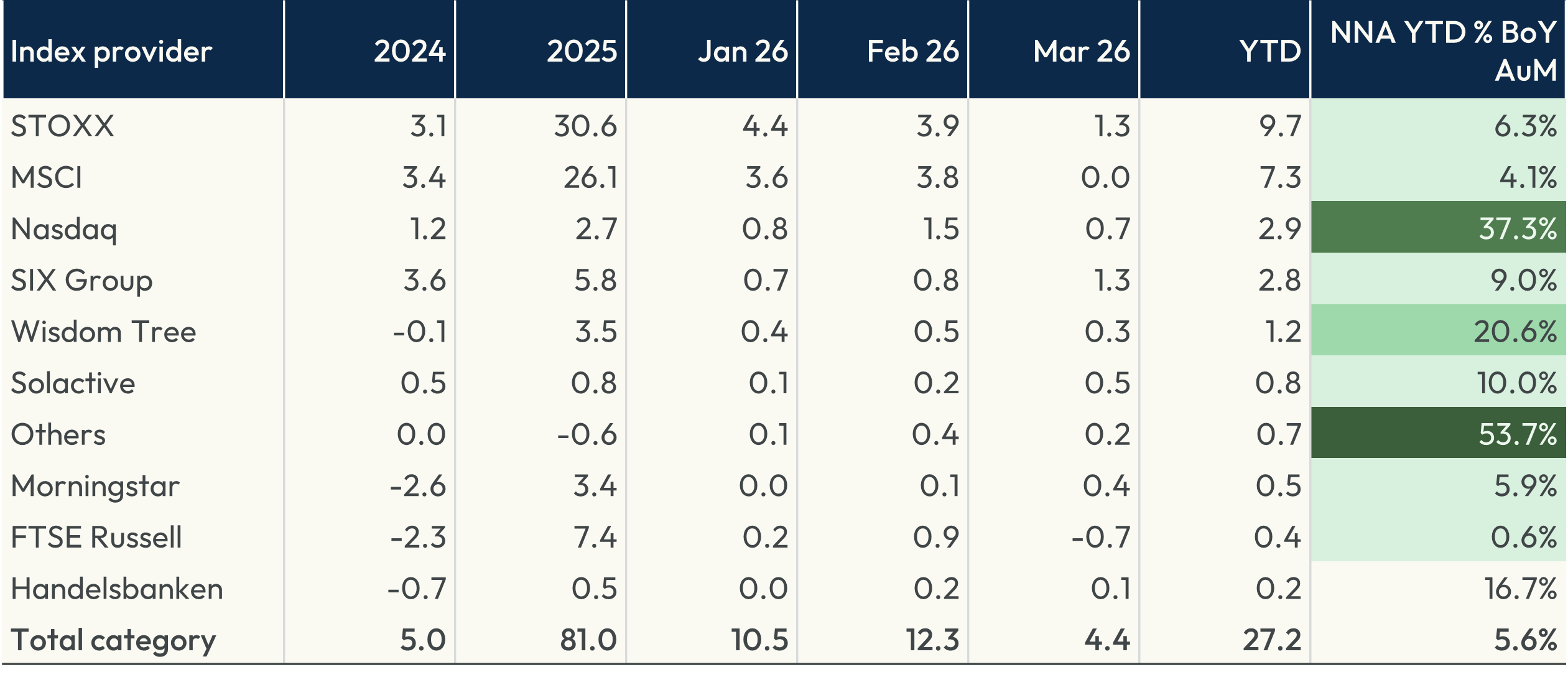
Exchange-traded funds (ETFs) tracking STOXX and DAX European equity indices attracted a net EUR 1.3 billion in March and EUR 9.7 billion in the first quarter, as investors sought exposure to the region’s benchmarks despite a market sell-off last month.[1]
The inflows represented 36% of all new investments into passive European equity ETFs over the quarter, according to STOXX data. ETFs invested in equities worldwide received EUR 66.2 billion in net investments in March, around half the amount recorded in each of the previous two months, but still a notable outcome given the sharp market decline over the month.
“Even as stock prices sustained heavy losses in March, positive ETF flows over the month suggest investors may have favored the liquidity, scale and diversification of benchmark strategies,” said Serkan Batir, Global Head of Product Development and Benchmarks at STOXX.
The EURO STOXX 50® plunged 9.1% last month when measured in euros and including dividends, while the pan-European STOXX® Europe 600 retreated 7.6%, as a surge in oil prices sparked fears of higher interest rates. It was the worst monthly showing for both indices since the COVID-19 pandemic broke out in March 2020. The benchmarks traded at a record high in February on a price-return basis. The STOXX® World AC Universal lost 7.3% in March and the STOXX® Global 1800 index dropped 6.4%, their worst month since September 2022.
Figure 1: European equities ETFs net new assets (NNA) Q1, EUR bn
Assets under management (AuM) across equity ETFs worldwide declined 3.9% in March from February to EUR 12.1 trillion, but still ended the quarter 2.2% higher than at the end of 2025, according to STOXX data. Assets in STOXX- and DAX-linked equity funds reached EUR 188.7 billion at the end of March, 2.9% higher than at the end of 2025.
Banks out, utilities in
All ETFs investing in European equities attracted EUR 27.2 billion in the first quarter, equivalent to 5.6% of assets at the beginning of the year. ETFs investing in stocks in the Americas lured EUR 82.6 billion over the three months, or 1.1% of assets.
While ETFs linked to benchmarks such as the STOXX Europe 600 and EURO STOXX 50 attracted investments in March, funds tracking the banking sector registered net outflows. Within the STOXX universe, utilities and energy were the sectors with the highest level of net inflows over the month. Brent crude topped USD 110 a barrel in London in March after Iran blocked tanker traffic through the strategic Strait of Hormuz in retaliation for US and Israeli military strikes.
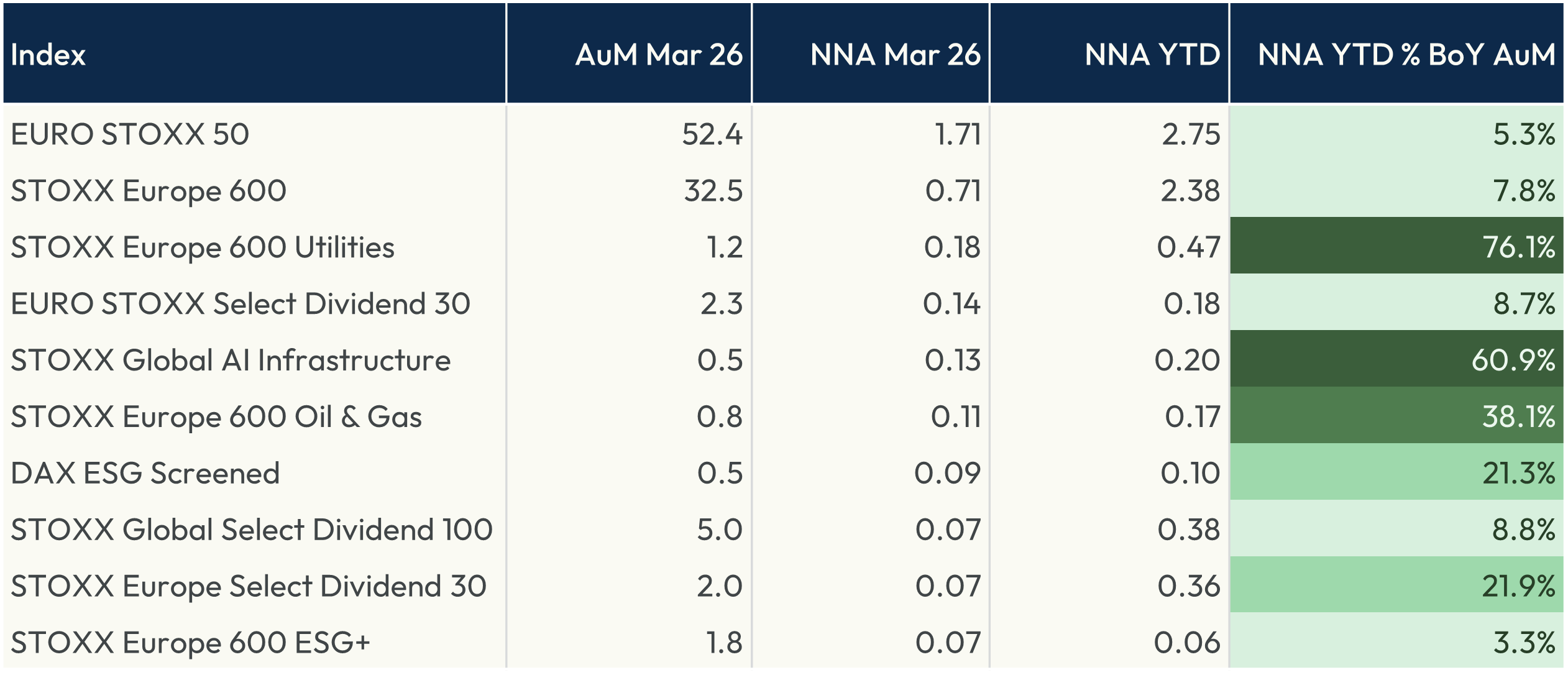
Figure 2 shows the top ten STOXX and DAX equity indices ranked by net investments into linked ETFs in March. The DAX ESG Screened index received EUR 90 million in net inflows in the month, even as the benchmark DAX saw outflows. Dividend strategies also attracted investments.
Figure 2: STOXX, DAX equity indices – AuM and NNA, EUR bn
First-quarter trends
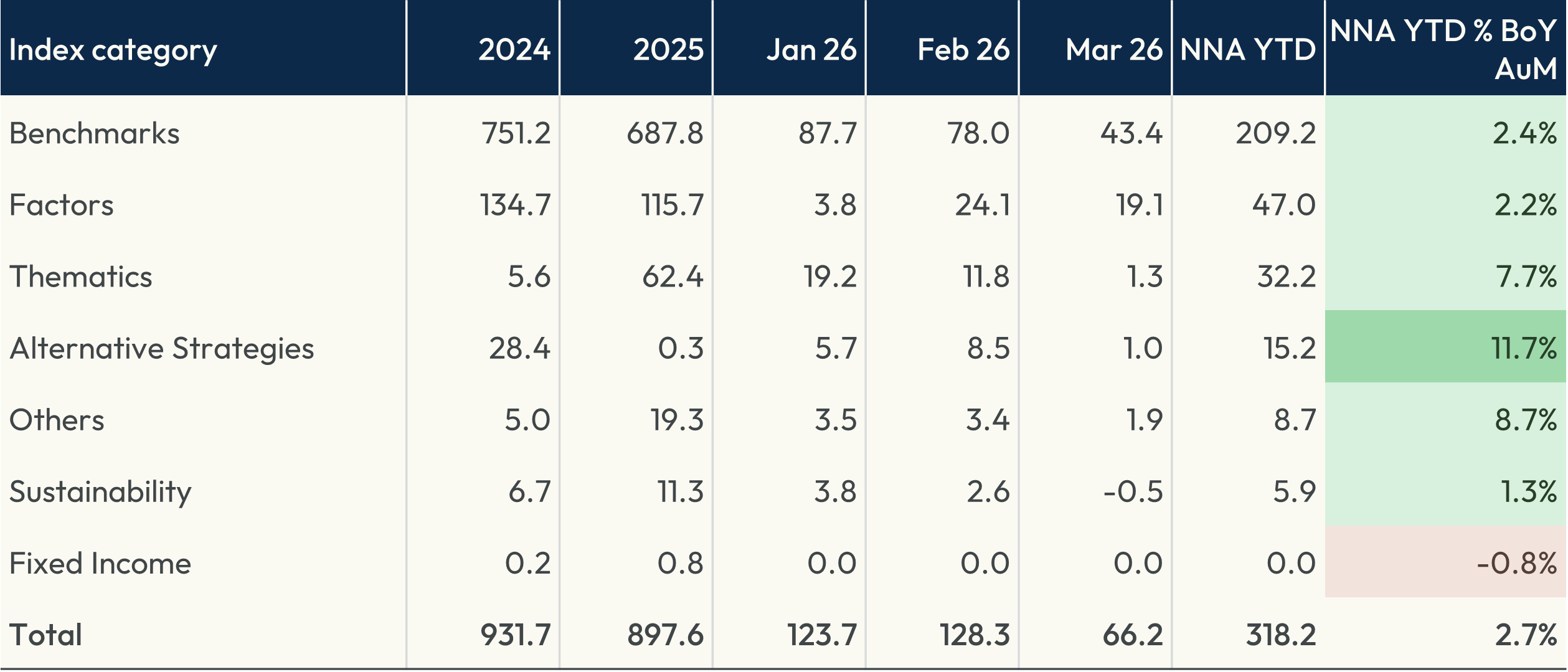
Globally, passive equity ETFs received EUR 318.2 billion in the first three months of 2026, or 2.7% of the funds’ assets at the start of the year (Figure 3). All regions, based on the ETFs’ investment objectives, had positive flows in the quarter.
ETFs tracking a benchmark received a net EUR 209.2 billion in the quarter, or 2.4% of the funds’ assets at the start of the year. Factor ETFs attracted the second-highest amount among all categories in the STOXX taxonomy, receiving EUR 47 billion, or 2.2% of assets. Thematic equity ETFs received EUR 32.2 billion, equivalent to 7.7% of existing assets.
Figure 3: Global passive equity ETFs’ Q1 NNA by segment, EUR bn
Five ETFs tracking a STOXX or DAX index were launched over the quarter: Deka STOXX Future Water ESG UCITS ETF, Amundi German Mid-Cap MDAX ETF, Xtrackers Europe Defense Technologies ETF, NZAM ETF DAX (Unhedged) and iShares Euro Dividend ETF.
[1] Data throughout the article includes passive ETFs.