
STOXX and EconSight, a Swiss technology-based analytics provider, have collaborated in recent years in the construction of thematic indices such as the STOXX® Global Metaverse.
EconSight’s unique patent classification system and indicators help analyze and sort companies by their intellectual property (IP) in cutting-edge technologies. The system enables the measurement of technological progress and the identification of players with innovation potential in more than 500 technologies, including brain-machine interaction, fuel cells or artificial intelligence (AI).
This data becomes structured information that can be integrated into STOXX indices to select companies that are likely to be tomorrow’s champions in technologies that are still developing. Such process is at the core of the selection methodology in several STOXX thematic indices, and in a 2023 interview EconSight’s two Managing Directors, Kai Gramke and Jochen Spuck, explained for this blog how their unique patents-based approach provides the needed input.
The two firms most recently teamed up for the design of two indices that target specific segments in the rollout of AI: STOXX® Global AI Infrastructure and STOXX® Global AI Adopters and Applications. The two indices underlie respective ETFs from BlackRock’s iShares.
For the occasion, we recently caught up with Kai (KG) to ask him, specifically, how the patents landscape can be navigated in the fast-evolving world of AI. We were joined by Ladi Williams (LW), Head of Thematics and Alternative Strategies at STOXX, who walked us through the process of stock selection in the AI indices.
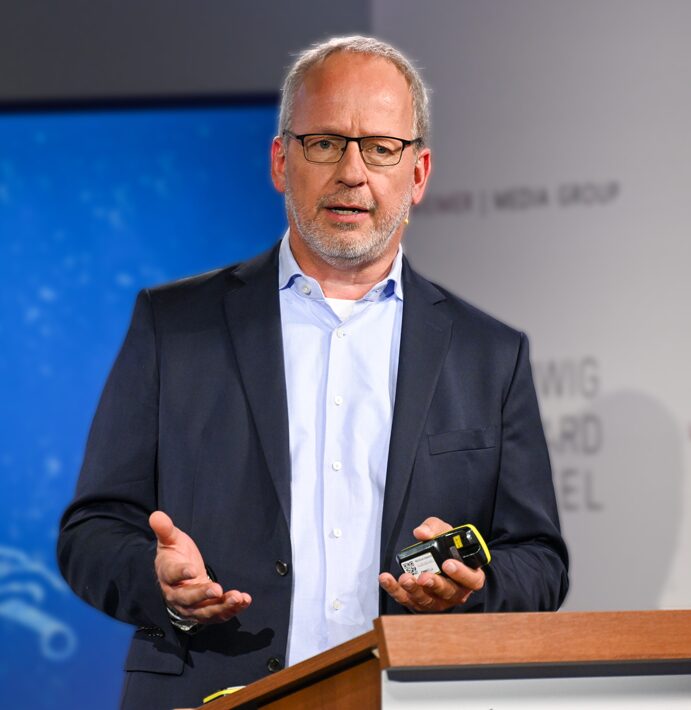
Kai Gramke, EconSight
Kai, AI is a vast and often complex theme. How do you define it in order to implement a patents search?
KG: “AI is not just a technology but a broad concept whose definition has changed repeatedly over time. We have followed the traces of machine learning from historical forms of rules-based systems (such as early chess engines) to modern AI methods, such as deep learning or neural networks. In total, we defined 15 distinct conceptual areas, covering both broad categories and highly specific technologies like transformer architectures and autoregressive models. This taxonomy allows us to map the patent landscape with precision and capture innovations across the full AI ecosystem.”
Can you give examples of what technologies are included in the various STOXX AI themes/indices?
KG: “In the STOXX AI indices, we have opted for a broad and inclusive definition of artificial intelligence to capture the full spectrum of technological innovation. Rather than focusing on AI in isolation, our emphasis is on concrete, high-impact applications — specifically where AI is being used to drive meaningful advances across key industries. In other words, who is using AI in the health, mobility or energy industries to develop revolutionary new products and services? It is precisely at this interface that we expect to see the most exciting developments.”
Ladi, how do the STOXX AI indices use patents in their selection process?
LW: “In both the STOXX Global AI Infrastructure and STOXX Global AI Adopters and Applications indices, companies are screened for their patent exposure to a list of relevant technologies. Companies must have at least one high-quality patent as defined by the EconSight proprietary scoring system to be eligible for selection. Patents are then further used to identify innovators by ranking companies from high to low, for each sub-theme related to the index, based on the total

Ladi Williams, STOXX
number of related high-quality patents that they have to the associated technologies. The top 20% of companies within each sub-theme ranking are selected.”
Kai, how do you classify the patents that are linked to AI?
KG: “Traditionally, we rely on a combination of patent classes and carefully curated keyword sets to identify relevant technologies. This method works well for mature areas where clear taxonomies already exist. However, for new technologies like generative AI, conventional classification systems fall short. GenAI is not yet formally classified in the international patent systems, which means there is no predefined place to find these innovations — we are navigating uncharted territory. To address this, we leveraged generative AI itself to define what constitutes a GenAI patent. We collaborated with the World Intellectual Property Organization (WIPO) and the published framework is emerging as a de facto standard.”
Are all patents equally important in the selection of a company?
KG: “No. There is a major distinction between patent quantity and patent quality. In 2024 alone, more than 2.5 million new patent applications were published globally, with China accounting for approximately 1.6 million of them — over 60%. If we were to rely purely on volume, Chinese companies would dominate every technological field. But volume alone is not a reliable indicator of innovation leadership. Our focus is on identifying the patents that matter — those that represent meaningful technological advancement and global relevance. To achieve this, we apply a proprietary patent scoring system to identify the top 10% of patents per technology. This quality-focused approach ensures that only high-quality patents form the foundation of the STOXX indices.”
Ladi, how does STOXX work with EconSight to select the appropriate technologies that works for the STOXX AI indices?
LW: “STOXX initially performs deep macroeconomic and market research, which allows us to better understand the key components and drivers behind a broad theme such as AI. This paves the way for us to define sub-themes and to work closely with EconSight to leverage their expertise within the field to identify the technologies in their taxonomy that are most relevant. It is a very collaborative process to ensure that the best outcomes are achieved.”
Finally, how does STOXX ensure that its AI suite keeps pace with developments in this fast-moving space?
LW: “Themes are constantly evolving. Capturing thematic exposures and reflecting their dynamic nature is a core concept of STOXX Thematic solutions. While the index methodology is rules-based, our Thematic Framework allows for constant re-evaluation of themes. We regularly review and update — if necessary — theme definitions to ensure that we keep pace with developments.”