
Responsible investing often prioritizes companies with the strongest sustainability credentials. While this approach maximizes a portfolio’s sustainability score, targeting companies at earlier stages in the sustainability transition could offer additional benefits as their practices improve.
The ISS STOXX ESG Climbers indices were designed to help investors identify exactly those companies. They select securities that have consistently enhanced their sustainability performance without setbacks. This provides a clear strategy for investors to participate in the sustainable transition while capturing potentially overlooked companies.
Combining the capabilities of STOXX and ISS STOXX Sustainability, the indices first apply standard screens to remove companies in controversial activities from a responsible-investing standpoint.[1] They then select companies whose Overall Numeric Rating from ISS STOXX Sustainability has risen in at least five quarters[2] over a rolling five-year period, and three quarters for existing constituents. Companies that have experienced any downgrade in their Rating over the same period are removed. The methodology also excludes securities with poor sustainability performance.[3]
Six indices are readily available[4]:
- ISS STOXX® Global 1800 ESG Climbers
- ISS STOXX® World AC ESG Climbers
- ISS STOXX® Europe 600 ESG Climbers
- ISS STOXX® Developed World ESG Climbers
- ISS STOXX® Emerging Markets ESG Climbers
- ISS STOXX® US ESG Climbers Industry Adjusted
As is customary with STOXX indices, the strategy can be applied to other stock universes to meet client needs.
Corporate Rating
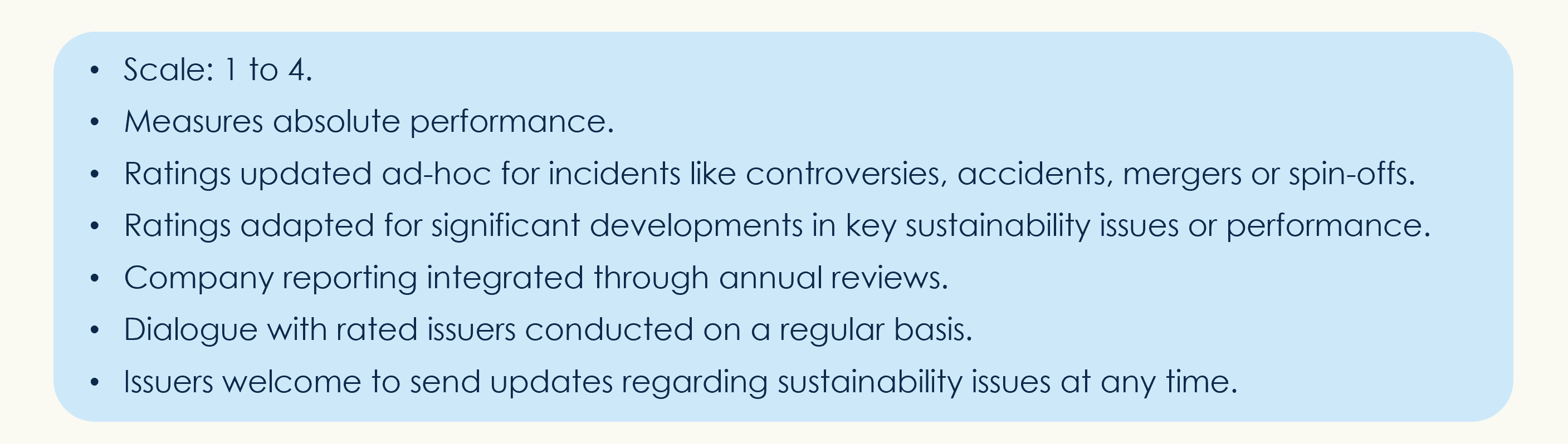
The Corporate Rating from ISS STOXX Sustainability provides a standard set of more than 30 universal ESG topics assessed for all companies. In total, nearly 140 factors, each accompanied by a rating and numeric score, are provided in the data feed. The rating itself is assigned on a scale ranging from A+ (Excellent) to D- (Poor), while the numeric scores range from 1 to 4.
Figure 1: Corporate Rating from ISS STOXX Sustainability
“The ISS STOXX ESG Climbers indices track companies demonstrating continuous improvement in their transition to more sustainable business models,” said Antonio Celeste, Head of Sustainability & Factors, Index Product Management, STOXX. “By following this strategy, investors can focus on companies’ long-term sustainability trajectory and have a built-in “up-or-out” escalation path: companies either advance their ESG record or are removed.”
As such, the ISS STOXX ESG Climbers indices provide a framework that can support investors with their sustainability-related corporate engagement, Celeste added.
The rise of sustainability indexing has introduced a more structural form of stewardship, embedded in index construction. By determining eligibility, exclusions and weightings, index methodologies — and the investors selecting them — can influence the allocation of passive capital at scale and shape corporate incentives.
ESG Climbers concept
Companies are considered to have improved their sustainability performance if their quarterly score changes by 0.025 or more within the 1-4 scale. Sustainability performance is deemed to have deteriorated if the score depreciation is at least -0.01.
Figure 2: Exclusions and stock selection in the ISS STOXX ESG Climbers indices

Risk and returns
Figure 3 shows comparative metrics for the ISS STOXX Europe 600 ESG Climbers and ISS STOXX US ESG Climbers Industry Adjusted indices relative to their benchmarks, while Figure 4 charts the indices’ performance. The European ESG Climbers index has beaten its benchmark significantly over the past five years, while the US ESG Climbers index has performed broadly in line with its benchmark.
Figure 3: Risk and return
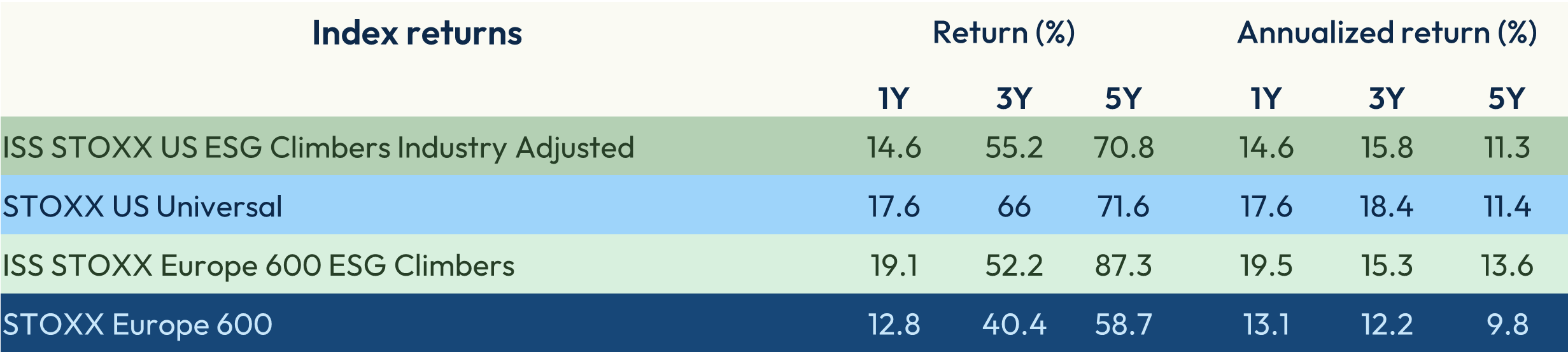
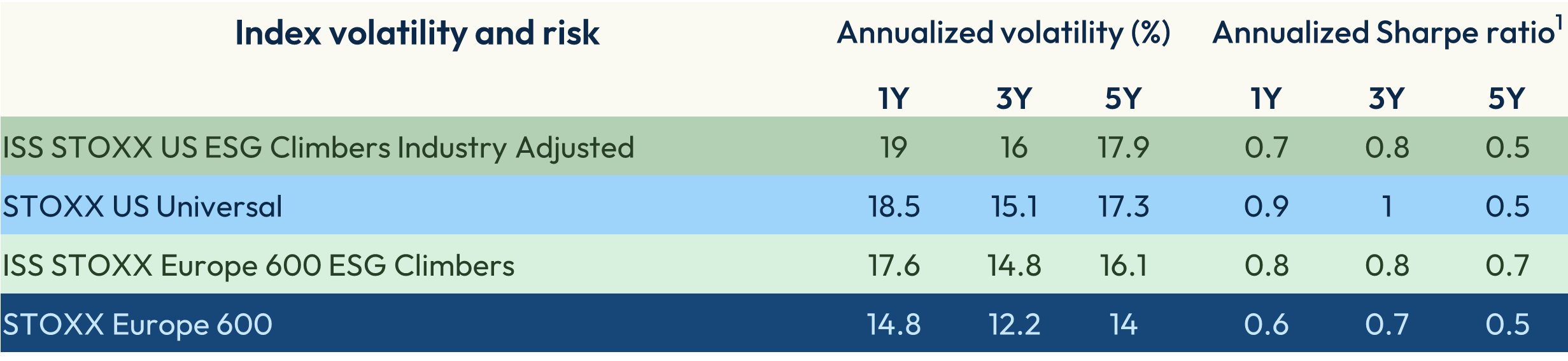
Figure 4: Five-year performance[5]
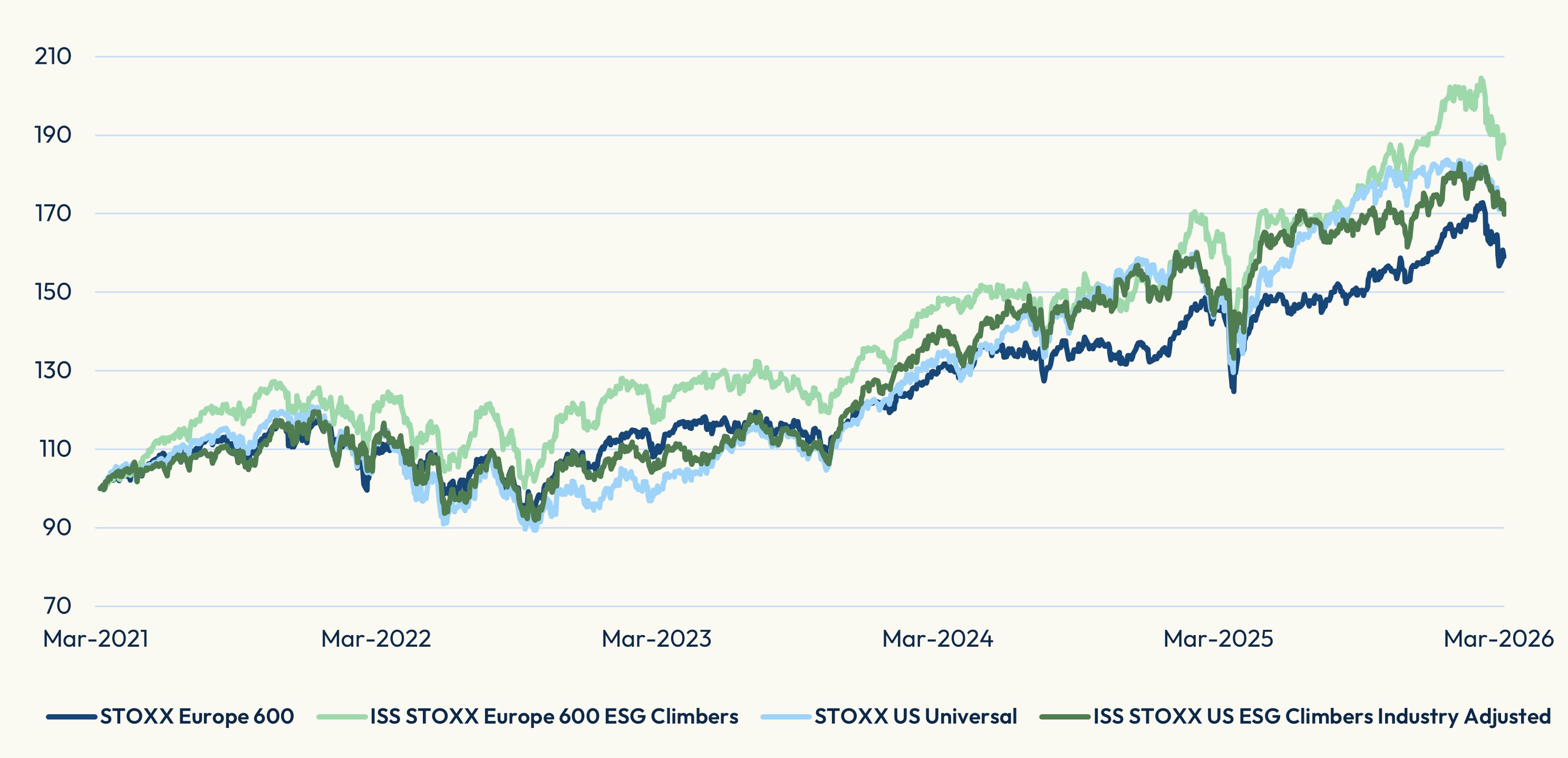
Over the past five years, the ISS STOXX Europe 600 ESG Climbers shows a tracking error of 5.7% to its benchmark.[6] The tracking error of the ISS STOXX US ESG Climbers Industry Adjusted is 6%.
Adjusted strategy
In the case of the ISS STOXX US ESG Climbers Industry Adjusted Index, securities are selected through an iterative process within each of the 11 ICB industries based on their Corporate Rating improvement and deterioration count. Stocks are then adjusted for industry exposure and subject to concentrated capping.
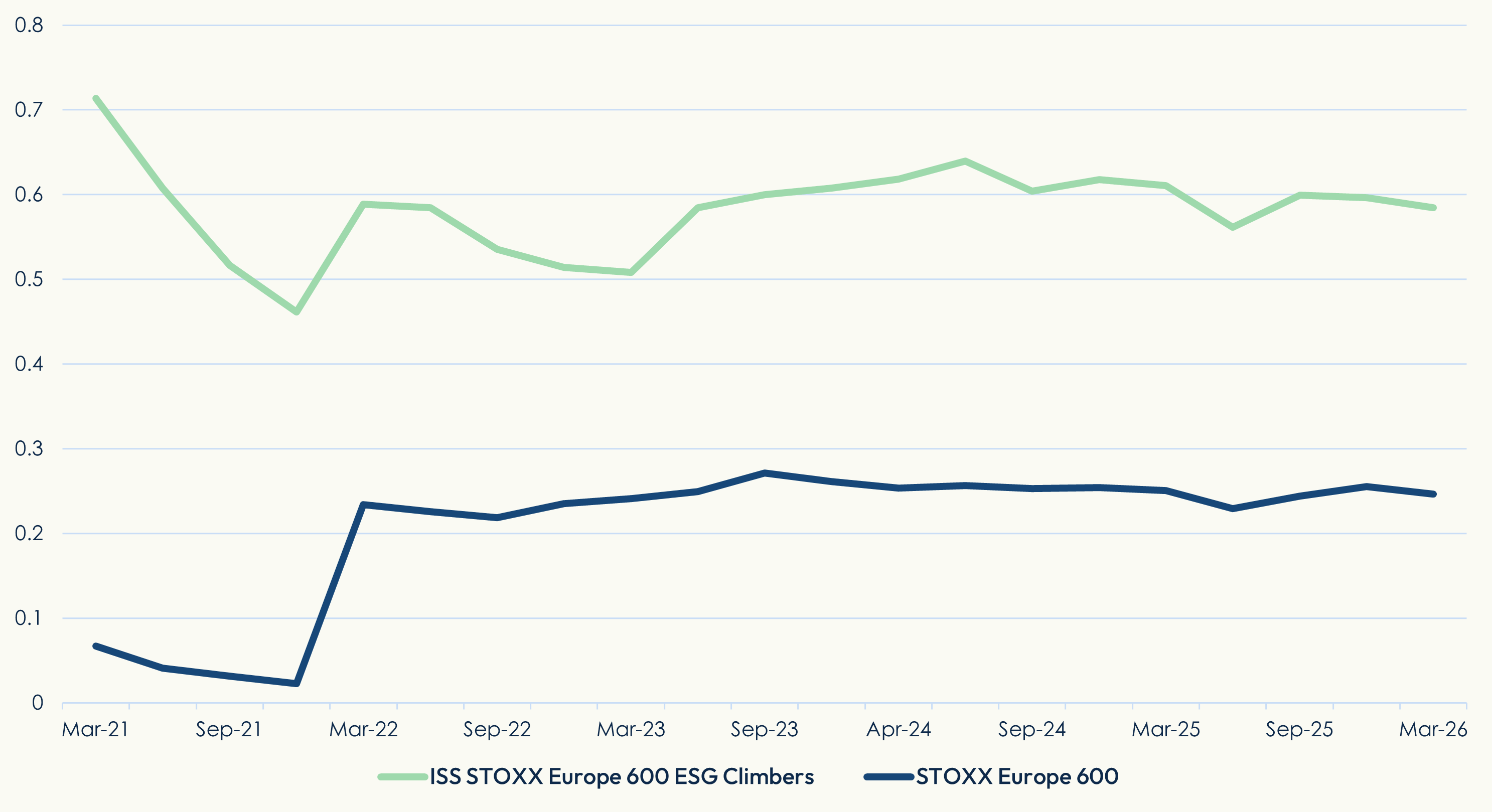
Figure 5 illustrates how the ISS STOXX ESG Climbers indices make consistent and larger-than-market sustainability progress over the long horizon. The chart compares the ISS STOXX Europe 600 ESG Climbers index’s average rolling five-year Corporate Rating score improvement against that of the parent index. Constituents in the STOXX Europe 600 benchmark show a much lower score improvement over the five years.
Figure 5: Rolling 5-year Numeric Rating change
Growing trading ecosystem
The ISS STOXX ESG Climbers indices are part of a growing set of solutions within the STOXX and DAX Sustainability family, whose strategies include exclusionary screening, positive integration and best-in-class sustainability, as well as low carbon, biodiversity and Paris-aligned benchmarks. The STOXX ICE Fixed Income Sustainability indices, meanwhile, help investors decarbonize bond portfolios.
The ecosystem of trading solutions around these indices also continues to expand. With an extensive set of derivatives, ETFs and structured products built around them, investors have increasingly more possibilities to align their portfolios with the most targeted objectives.
[1] Exclusion screens are applied for international norms on human rights, labor standards, environmental protection and anti-corruption, as well as product involvement on Controversial Weapons, Tobacco, Thermal Coal, Unconventional Oil & Gas, Civilian Firearms and Military Equipment.
[2] Three quarters for emerging-markets stocks.
[3] Poor ESG performers are deemed as those companies with an ISS Corporate Rating lower than 1.75. Securities with no Corporate Rating are also excluded from the indices at the index review.
[4] The indices are weighted by free-float market cap and carry on the same liquidity constraints as their starting-universe benchmarks. Components are capped at UCITS bounds (4.5/8/35).
[5] The ISS STOXX Europe 600 ESG Climbers Index was launched on March 28, 2024. Data prior to the launch date is back-tested data (i.e. calculations of how the index might have performed over that period had the index existed). There are frequently material differences between back-tested performance and actual results. Past performance — whether actual or back-tested — is no indication or guarantee of future performance.
[6] Data as of February 27, 2026.