
SEI®[1] has launched an exchange-traded fund (ETF) tracking the iSTOXX® Ang Research Enhanced U.S. Large Cap index, which is designed to deliver improved factor-based performance through research and optimized allocation.
The SEI Ang Research Enhanced U.S. Large Cap ETF was listed on Nasdaq today. The underlying index, introduced in June, stems from the collaboration between STOXX and factor investing pioneer Dr. Andrew Ang. It employs three proprietary factor timing models — Market Similarity, Factor Momentum, and Factor of Factors — to dynamically allocate weights across four factor styles when constructing a multifactor score[2]. The portfolio is then optimized to maximize the exposure to the multifactor score with additional constraints.
The index methodology is based on the premise that factors perform differently across market regimes, so their weights should adjust rather than rely on a static blend. Modern factor definitions, and the Axioma portfolio optimizer that constraints on criteria including tracking error and turnover, are also used to decide the final index constitution.
“This launch highlights how innovative index design can be translated into practical investment implementation,” said Arun Singhal, Head of Product Management and Client Success at STOXX. “Through our collaboration with Andrew and his expertise in factor investing and systematic portfolio design, we are creating an index suite intended to deliver better portfolio outcomes over time,” he added, “while preserving the consistency, visibility, and governance investors expect from STOXX.”
Advances in factor investing
Factor ETFs were once dominated by single-style tilts — such as Value or Growth — a straightforward approach that nonetheless offered little diversification. Multifactor strategies followed, blending several styles to balance out that exposure. The current stage of factor research goes a step further, examining which factor combinations most effectively capture above-market returns and enhance overall performance. A recent STOXX study shows the iSTOXX Ang Research Enhanced U.S. Large Cap index has delivered on that objective.
The factors
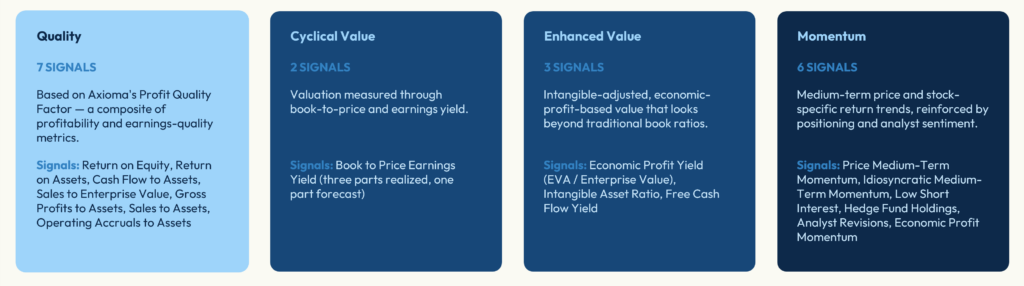
The index tilts on four factors — Momentum, Quality, Enhanced Value and Cyclical Value — each built on multiple signals and rooted in the latest academic literature. The first two are common in factor investing and have been designed for this index using novel signal definitions, including short interest and hedge fund holdings.
The last two aim to capture Value comprehensively — from economic profit to contemporary balance-sheet drivers. Cyclical Value comprises traditional value metrics: book-to-price and earnings yield. Enhanced Value is meant to address the shortcomings of those popular metrics by measuring value that is not adequately captured in bookkeeping, including economic profit yield, intangible asset ratio and free cash-flow yield.
Figure 1: Targeted factors
Factor rotation models
The index’s edge lies in how it allocates across factors: three proprietary models — described below — continuously reassess conditions and dynamically shift exposure.
- Market Similarity model: it applies machine learning to find the most similar market conditions to today and estimates the probability of benchmark-relative outperformance of each of the four single factors.
- Factor Momentum model: it ranks factors by their 18-month Factor Information Ratio versus the parent benchmark, then increases the weight of rank leaders and reduces that of laggards.
- Factor of Factors model: it identifies extremes in factor exposures across the market. It reduces weight in crowded factors and vice versa — avoiding reversal risk.
Each of these models produces an allocation to the four single factors, which are then combined to build the final dynamic multi-factor score.
The optimized index is additionally constrained by limits on asset holdings, industry exposure, turnover, liquidity, tracking error, beta and factor exposure limits.
Testing returns
Analysis in a recent STOXX whitepaper found that the index has had strong outperformance over a 22-year backtest, producing an annual active return of 1.2 percentage points versus the STOXX® US Universal parent index, while maintaining a 1% tracking error (Figure 2). The findings suggest that a well-constructed, diversified multifactor index can sustain outperformance over decades with nominal trading costs, the study’s authors wrote.
Figure 2: Summary of backtest results March 2004 – May 2026
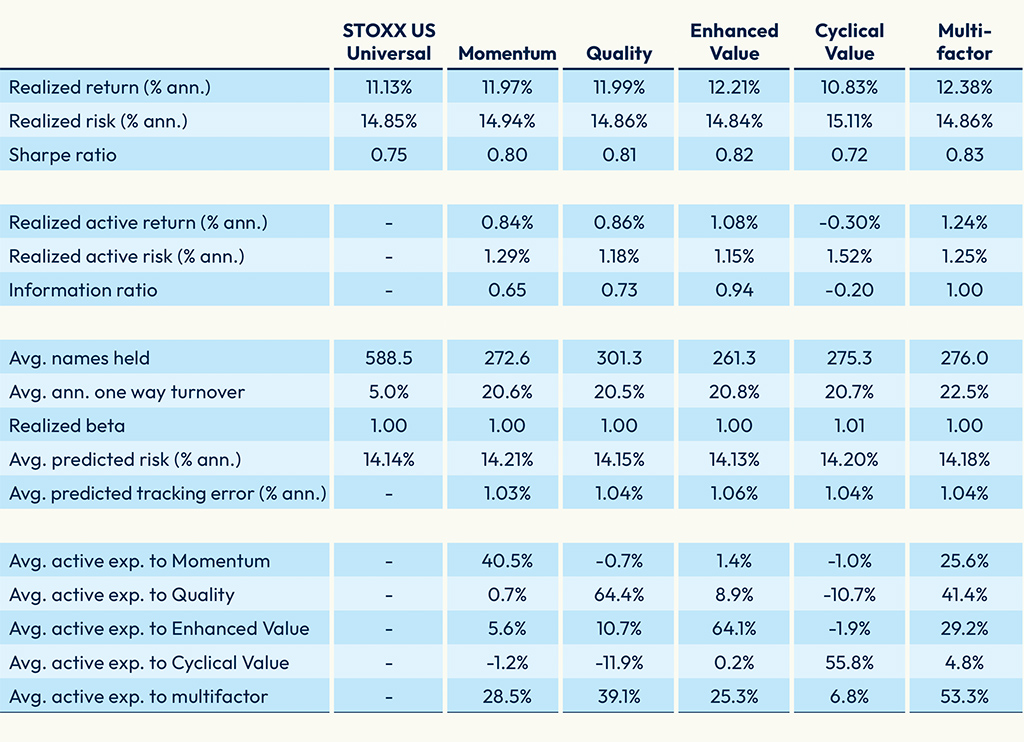
Source: STOXX, “Real world diversification in Multifactor indices.” USD gross monthly returns.
The observed long-term outperformance occurs because the multifactor score[3] has been explicitly diversified — and each single factor score is itself built from multiple input signals, adding a further layer of diversification, the authors argue.
Figure 3: Performance chart
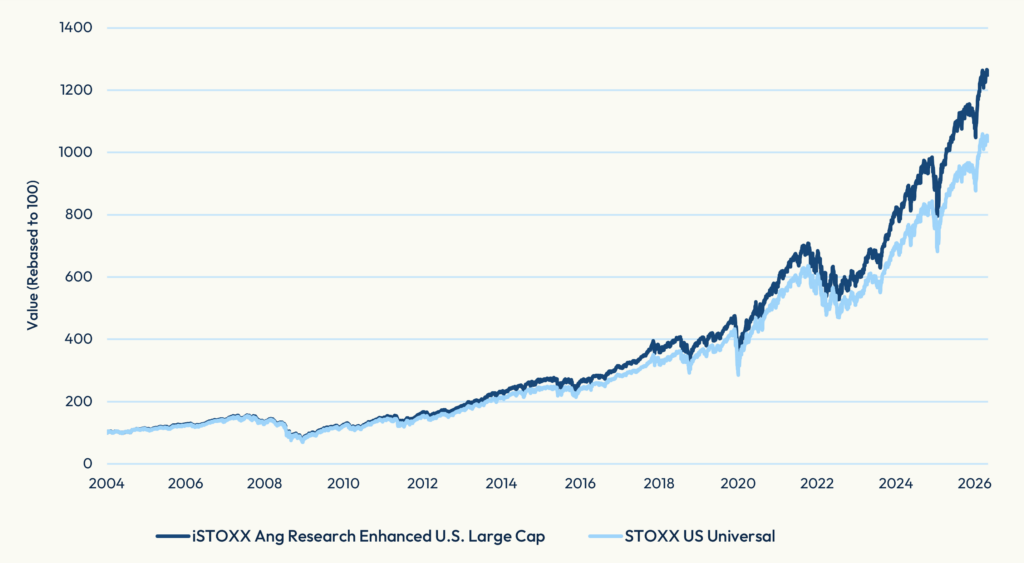
Source: STOXX. USD gross returns through July 21, 2026. Normalized at 100 on March 22, 2004.
The low tracking error ensures that none of the US market’s megacap stocks are strongly underweighted. This matters to investors given the strong performance in recent years of the so-called Magnificent Seven and FAANG companies.
Figure 4: Index sector allocation
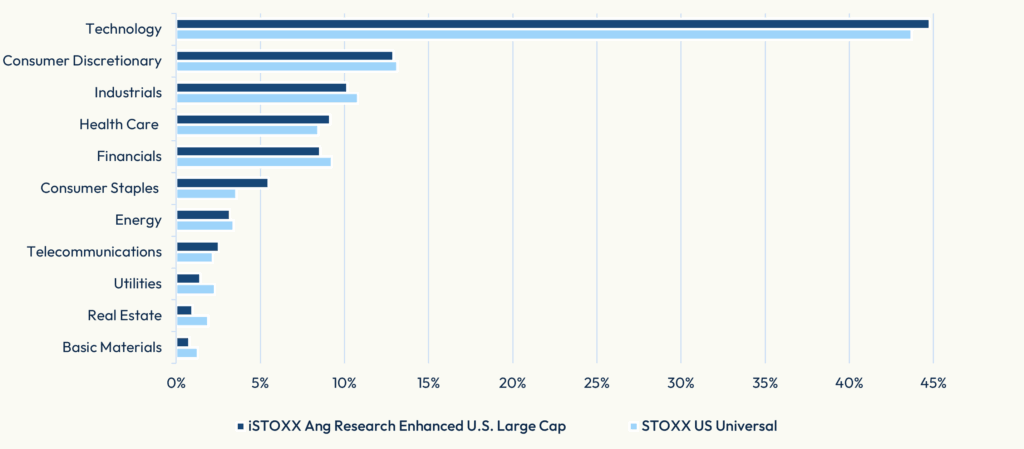
Source: STOXX. Data through June 10, 2026.
25 years of factor innovation and customization
Recognizing that factors are not equally rewarded at all times is key to a successful investment strategy, Dr. Ang — a former Columbia Business School professor — said in a recent interview. At the same time, unintended factor exposures, high tracking error and costly trading turnover are all “places of leakage,” he added.
STOXX’s factor index suite, built over 25 years of innovation, has more than EUR 44 billion in related investment vehicles. This latest collaboration with Dr. Ang continues that path of bringing research-led dynamism and customization into index design.
[1] SEI is a leading global provider of financial technology, operations and asset management services.
[2] The Momentum, Quality, Enhanced Value and Cyclical Value Factor Scores are each an equally weighted combination of their respective individual Signals. Each individual Signal is Z-scored using the parent index weights and truncated at +/- 3 standard deviations. The equally weighted combination is Z-scored again and truncated at +/-3 standard deviations.
[3] The Multifactor Score is a weighted combination of the Momentum, Quality, Enhanced Value and Cyclical Value Factor Scores.