
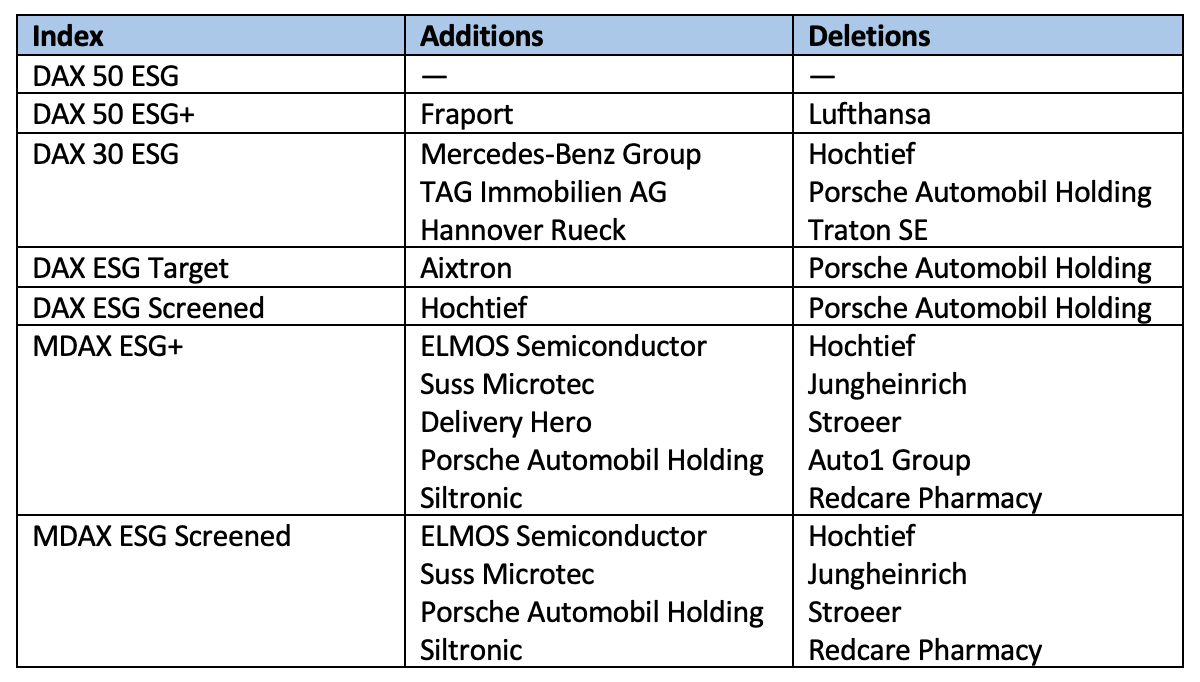
STOXX has announced the results of the June composition review of the DAX® 50 ESG, DAX® 50 ESG+, DAX® 30 ESG, DAX® ESG Target, DAX® ESG Screened, MDAX® ESG+ and MDAX® ESG Screened indices. The actions listed in this article will be effective as of June 22 this year.
Figure 1: DAX ESG indices — Review results
ESG exclusions
All DAX ESG indices listed above apply negative screening criteria to exclude companies that fail to meet certain index-specific ESG requirements. Companies are deemed ineligible for index inclusion if they breach criteria such as norms-based screening[1] or controversial weapons screening[2], or if they are involved in business activities related to fossil fuels, tobacco, nuclear power or military equipment, among others.
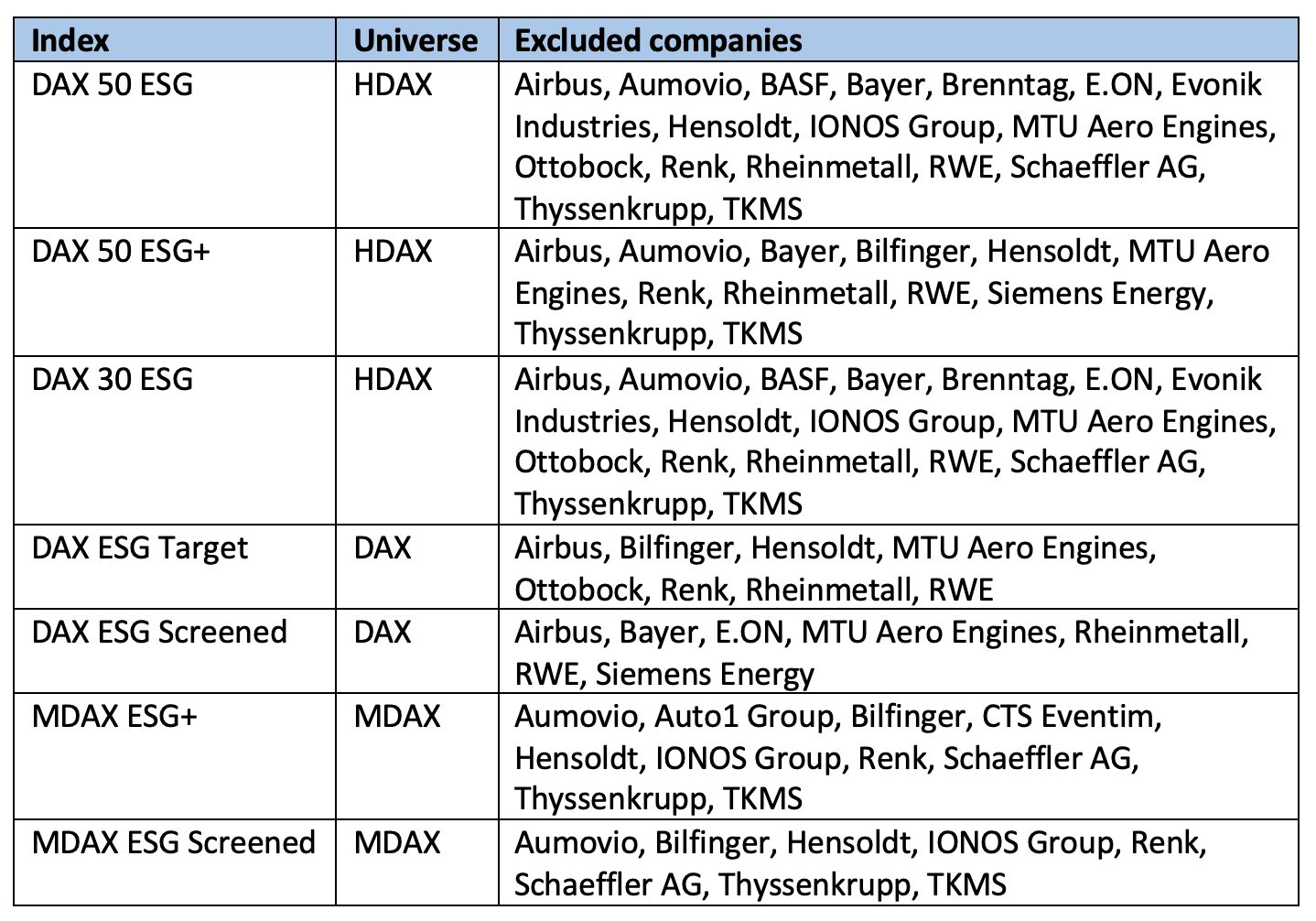
The table below lists companies that failed to meet ESG criteria across the DAX ESG indices in the June 2026 review.
Figure 2: DAX ESG indices – Excluded companies
Performance Score – DAX 50 ESG, DAX 50 ESG+, DAX 30 ESG
For DAX 50 ESG, DAX 50 ESG+ and DAX 30 ESG, components are selected from HDAX® based on their ISS Sustainability Performance Score, which evaluates companies’ ESG-related risks, opportunities and impact along the corporate value chain. To calculate the Score, individual ratings in the areas of environment, social issues and corporate governance are combined and aggregated. The ISS Sustainability Performance Score ranges from 0 to 100, with 100 representing the top rating.
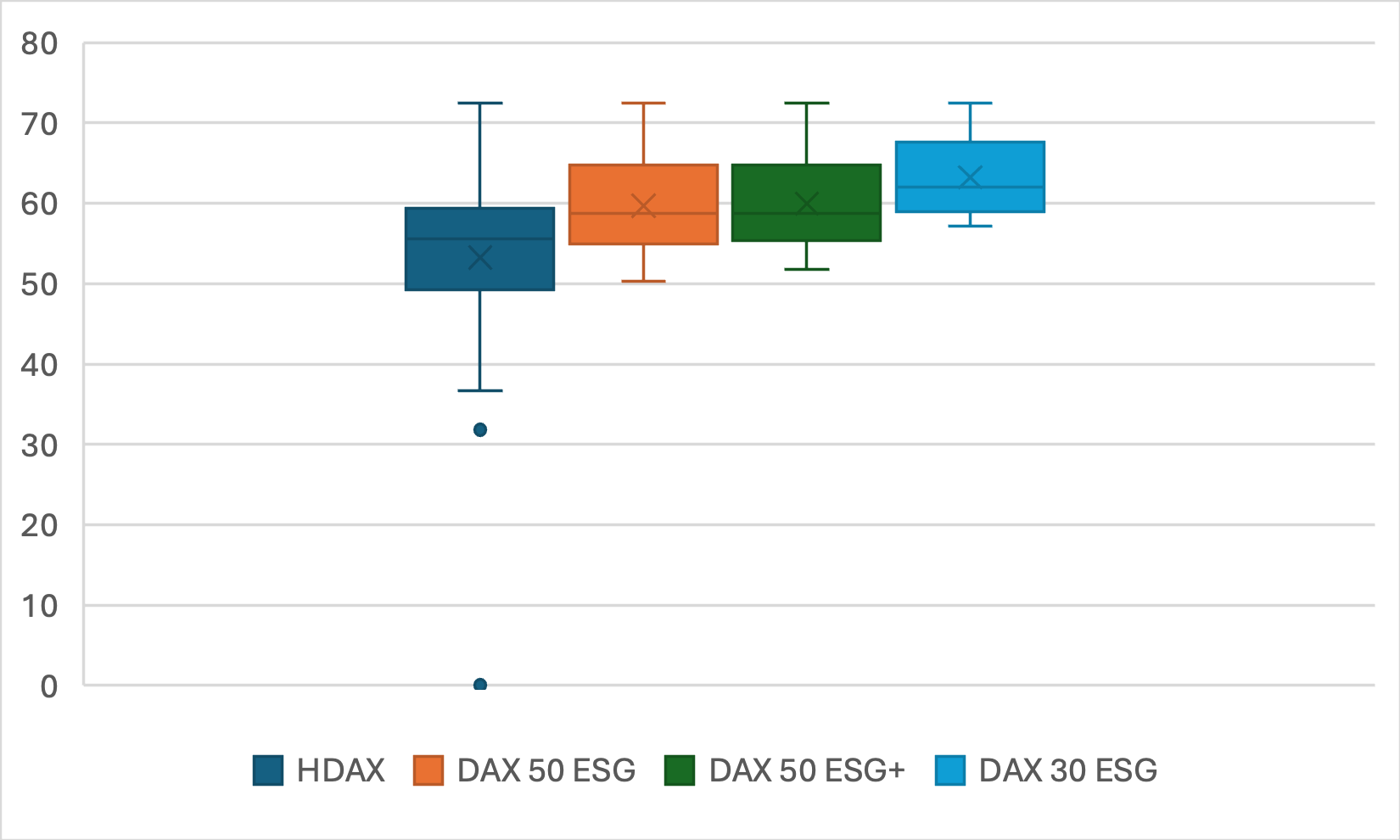
As of June 2026, DAX 50 ESG, DAX 50 ESG+ and DAX 30 ESG exhibit higher average ISS Sustainability Performance Scores across their components compared to the HDAX. The DAX 50 ESG and DAX 50 ESG+ each show an average score 12% above the HDAX, while the DAX 30 ESG outperforms by 18%.
Figure 3: Distribution of ISS Sustainability Performance Scores across all index components
The companies with the highest ISS Sustainability Performance Scores in HDAX are SAP, Fresenius, Henkel, Nordex and Puma. All of them are included in DAX 50 ESG, DAX 50 ESG+ and DAX 30 ESG.
Greenhouse gas intensity for DAX ESG indices
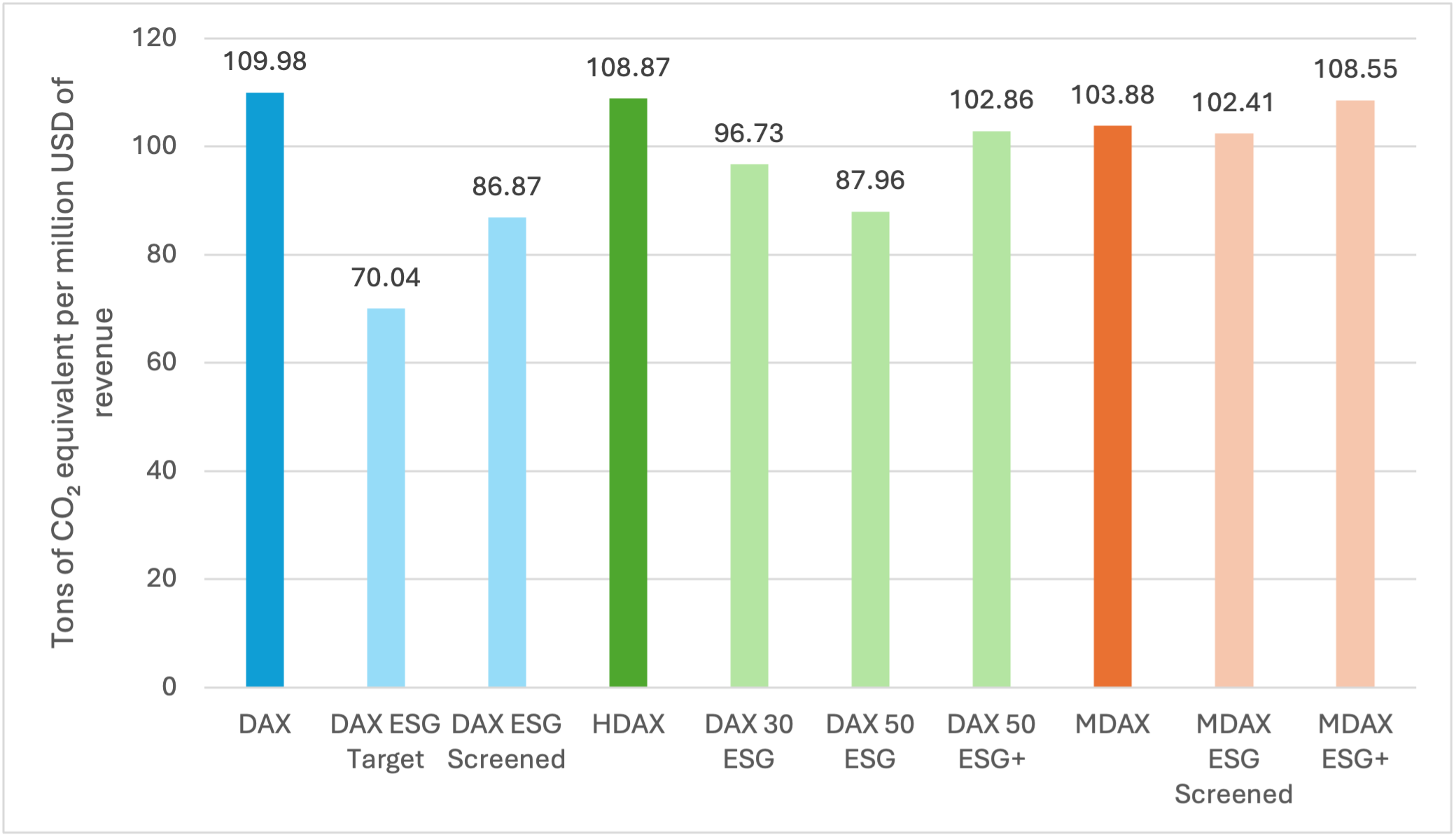
Among the DAX ESG indices, components of DAX ESG Target exhibit on average the lowest greenhouse gas (GHG) intensity, while constituents of the MDAX ESG+ record the highest. DAX ESG Target also shows the largest reduction of GHG intensity compared to its parent index, DAX.
GHG intensity, as compiled by ISS Sustainability, reflects Scope 1 and Scope 2 GHG emissions expressed in metric tons of carbon dioxide equivalent per million US dollars of revenue. The higher the intensity, the more metric tons of carbon dioxide are emitted to generate one million dollars of revenue.
Figure 4: GHG intensity – DAX ESG indices vs. parent index
Comprehensive suite
The DAX 50 ESG combines negative screening, best-in-class ESG integration, and reflects the performance of the 50 highest ESG-ranked German companies. It was developed as a broad-market ESG benchmark with a larger composition than that of the flagship DAX.
The DAX 50 ESG+ is similar to the DAX 50 ESG but applies different sustainability exclusion filters.
The DAX 30 ESG excludes controversial companies from a starting universe, and from the largest remaining companies selects the 30 securities with the highest ESG Performance Score from ISS Sustainability.
The DAX ESG Target follows an optimized weighting methodology whose objective is to minimize the tracking error while achieving improvements over the benchmark in terms of carbon footprint and ESG Risk Score.
The objective of the DAX ESG Screened index is to reflect the performance of the DAX after removing companies that fail screenings for global norms, controversial weapons, product involvement and a minimum ESG rating.
The MDAX ESG indices follow similar methodologies as the DAX ESG indices while tracking mid-cap companies.
The selection universe for the DAX 50 ESG, DAX 50 ESG+ and DAX 30 ESG is the HDAX, which consists of all companies in DAX, MDAX and TecDAX. Changes to the composition in the ESG indices might be caused by changes in the starting universe. Likewise, changes in the MDAX® universe may result in additions or deletions in the MDAX ESG versions.
The next regular review of the DAX ESG indices will take place on September 4, 2026.
Separately, STOXX announced June 3 changes to the DAX Selection indices, which include the blue-chip DAX, as part of the regular June review.
The DAX ESG suite continues to provide structured exposure to German equities while integrating ESG considerations through transparent and rules-based methodologies.
[1] Companies are assessed against their adherence to international norms on human rights, labour standards, environmental protection and anti-corruption established in the UN Global Compact and the OECD Guidelines. Companies identified as ‘Red’ are excluded. ISS-ESG identifies companies are ‘Red’, if they are failing to respect established norms and where the issue remains unaddressed.
[2] Companies must not be involved in controversial weapons activities, as identified by ISS Sustainability. The following weapons are defined as controversial: anti-personnel mines, biological weapons, chemical weapons, cluster munitions, depleted uranium programs, nuclear weapons (including non-NPT countries, i.e., countries not belonging to the Nuclear Non-proliferation Treaty), and white phosphorus.