
Sixty-one of Germany’s largest companies have pledged to invest a combined EUR 631 billion by 2028, joining government efforts to kickstart Europe’s largest economy.
The ‘Made for Germany’ initiative was presented on July 21 in a bid to “drive innovation, generate employment, and boost competitiveness,” the signatory firms said in press releases[1]. Among them are 29 DAX constituents, including BASF, BMW, Deutsche Bank, Deutsche Börse, Volkswagen and Siemens, whose top executives called for increased market and economic deregulation.
Investors have turned to German stocks this year as the new government of Chancellor Friedrich Merz seeks to stimulate growth by loosening fiscal constraints and launching an ambitious infrastructure and defense spending program. The DAX®, Germany’s blue-chip benchmark, has jumped 20.1%[2] in 2025 while EUR 7.3 billion has flowed into passive ETFs focused on the German equity market.[3]
The MDAX®, which tracks Germany’s mid-sized companies, has climbed 19.1% in 2025 while the SDAX®, which follows the performance of smaller companies, has surged 28.1%.[4]
By comparison, the STOXX® World AC index has fallen 2.6% in euros this year. The pan-European STOXX® Europe 600 has risen 9.4%.
Infographic: The power of Germany’s DAX
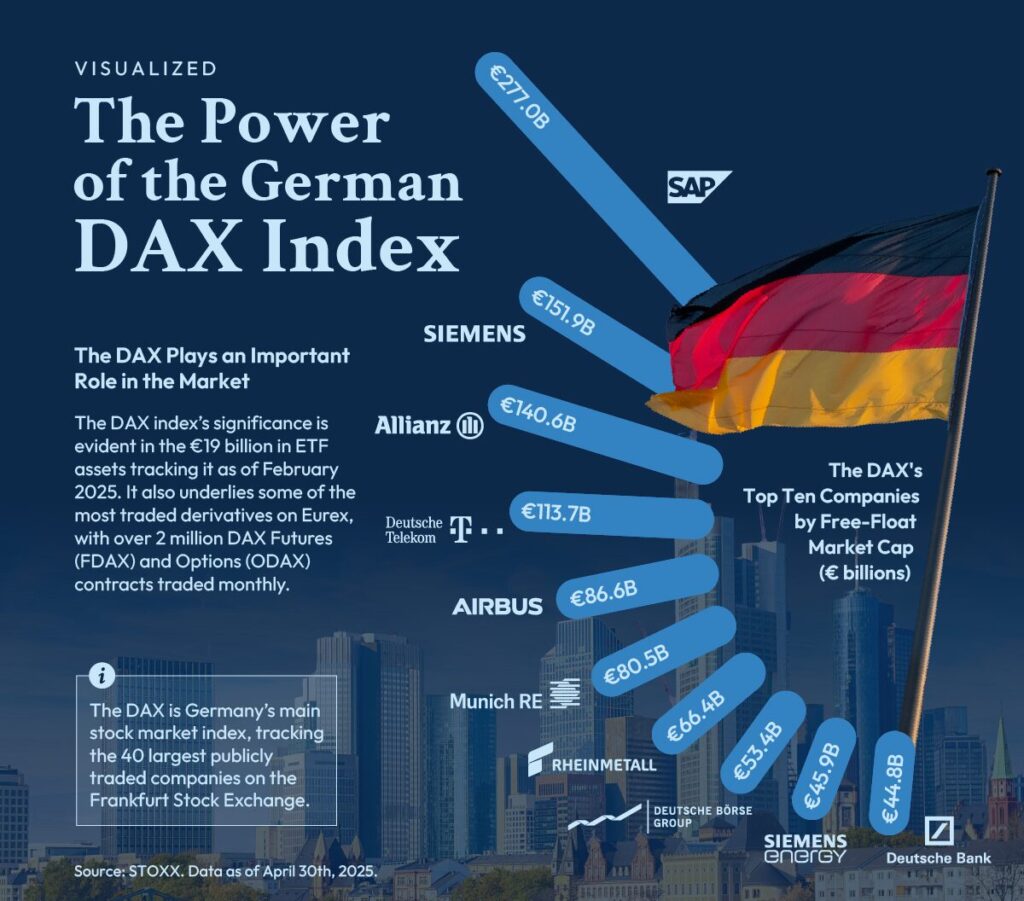
Source: STOXX.
“We are facing one of the largest investment initiatives that we have seen in Germany in recent decades,” Chancellor Merz said at a news conference following the presentation of the investment plan, according to Reuters.[5] “The investment tasks we are facing cannot be achieved by public budgets alone. On the contrary, the lion’s share must be provided by private investors.”
“Germany’s economy needs a jumpstart,” Stephan Leithner, CEO of Deutsche Börse, wrote in a LinkedIn post. “And when politics and industry work together, true progress is possible. That’s why we are supporting #MadeForGermany – an alliance for a strong, successful and sustainable Germany, for us and future generations.”
The German central bank has forecast the local economy will stagnate in 2025, but expand 0.7% in 2026 and 1.2% in 2027.[6]
[1] See: Press release, Deutsche Bank, July 21, 2025.
[2] All performances in the article reflect total returns in euros through June 2025.
[3] Data from STOXX as of July 10, 2025. Includes all passive ETFs investing in German equities. Around 80% of net flows into German equities ETFs this year went to a DAX family index.
[4] All figures are total returns in euros through June 2025.
[5] Reuters, ‘German firms launch ‘Made for Germany’ investment initiative,’ July 21, 2025.
[6] Deutsche Bundesbank, ‘The Bundesbank’s forecast for Germany: Economic recovery slowly getting started,’ June 6, 2025.