
While German equities delivered a strong rebound in the three months ending in June, the third quarter showed a more subdued performance environment and a changing set of sector leaders.
The benchmark DAX® gained 1.2%[1] between the last index review implementation date on June 22, and September 18, 2026 (Figure 1), reaching a new all-time high in August. That compares with an 11.6% advance between March 23 and June 19.
Over the June-September period, MDAX®, SDAX® and TecDAX® all posted declines, following gains of at least 10% in the previous three months and suggesting investors favored large caps over smaller counterparts.
Whereas the March-June period saw a sharp recovery from the turmoil surrounding the Iran war earlier in the year, the third quarter was marked by concern about rising interest rates and the potential impact of high oil prices on inflation. Investors rotated into value sectors such as financials, which may benefit from rising interest rates, and away from highly priced sectors such as semiconductors.
Figure 1: 6-month and 3-month performance of DAX index suite
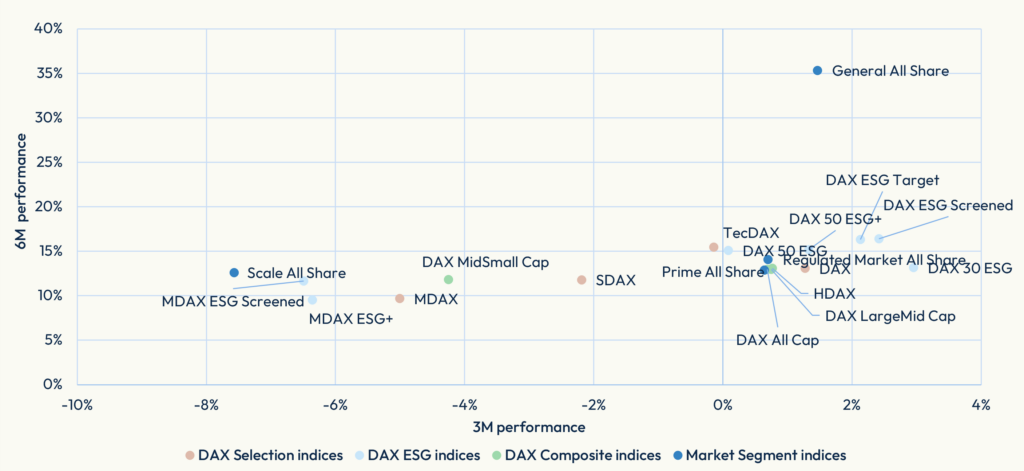
Through September 18, the DAX has gained 3.3% in 2026, the MDAX has advanced 1.5% and the SDAX has climbed 5.4%. The TecDAX, meanwhile, has added 9%. That compares with a 10.3% gain for the Eurozone’s EURO STOXX 50® benchmark.
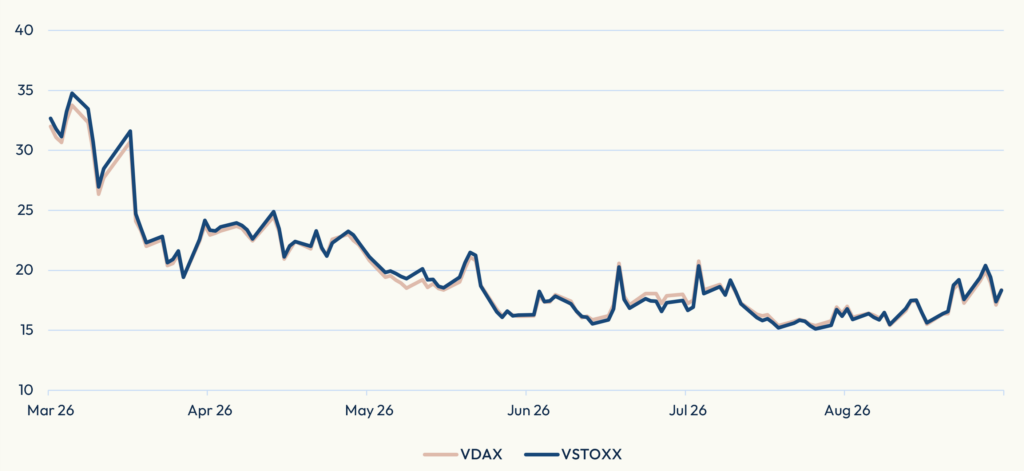
The more muted trading environment in the June-September period was also reflected in volatility: the VDAX® was lower over the three months than it did over the March–June period (Figure 2). The VDAX also performed in line with the VSTOXX® (EURO STOXX 50® Volatility) index.
Figure 2: German equity volatility as measured by VDAX index
FIRE, tech and healthcare lead the gains
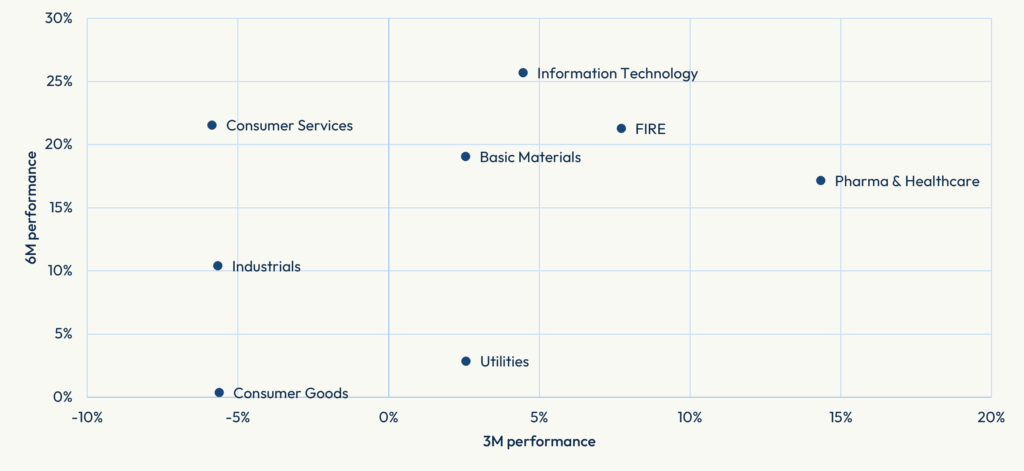
Three Supersectors were the main engines of DAX performance since the end of June (Figure 3):
- Financials, Insurance and Real Estate (FIRE)
- Information Technology
- Pharma & Healthcare
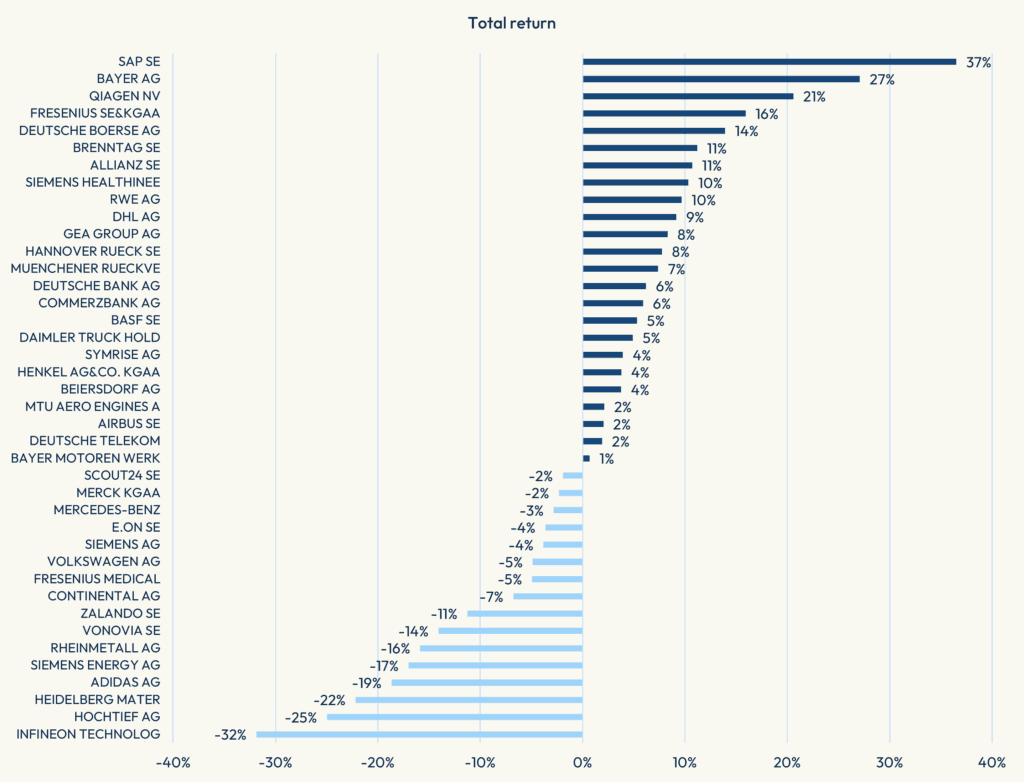
While FIRE and Information Technology have seen sustained buying interest for several months, German Pharma & Healthcare emerged as a top performer only since June. Returns were driven predominantly by company-specific factors, led by Bayer (+27%), Qiagen (+20%) and Fresenius SE (+15%).
Figure 3: 6-month and 3-month performance of DAX Supersector indices
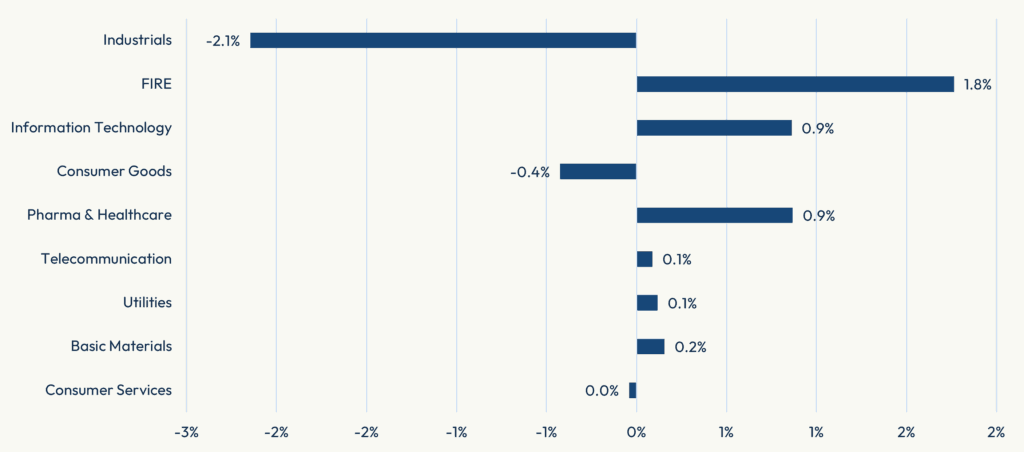
The FIRE Supersector stood out in particular last quarter, adding 1.8 percentage points to the benchmark’s return since the last review — the largest contributor to DAX performance over the period (Figure 4). Returns were driven by Deutsche Börse (+14%), Allianz (+11%), Hannover Rück (+7.8%), Munich Re (+7.4%), Deutsche Bank (+6.2%) and Commerzbank (+5.9%). With a 22% weight in the index, FIRE is DAX’s second-largest Supersector, giving these gains substantial sway in the benchmark.
At the other end, DAX’s largest Supersector, Industrials, was a drag, cutting 2.1 percentage points off DAX’s performance since June. The decline was driven mainly by Siemens Energy (-17%) and Rheinmetall (-15.9%).
Figure 4: DAX performance contribution by Supersector since end-June
SAP and Infineon: A tale of two tech stocks
No single stock shaped DAX’s performance over the last three months more than SAP. The stock climbed 36%, the best performance of any DAX component, contributing 2.8 percentage points to the index’s return. The rally helped SAP reclaim its position as the DAX’s largest constituent, with a weight of around 11%.
At the opposite extreme sits Infineon, DAX’s worst performer since June, down 32% and subtracting roughly 2 percentage points from index performance. Infineon’s index weight has fallen from 6.5% to around 4%. Notably, SAP and Infineon both sit within the Information Technology sector, yet their diverging fortunes illustrate just how differently market trends have played out across sub-segments of tech over the past quarter, as software and enterprise IT held up far better than semiconductors.
Figure 5: Performance of DAX components since June review
ESG indices benefit from sector tilts
The divergence in Supersector performance had a clear knock-on effect for DAX’s ESG-screened indices. Because these indices carry greater exposure to the FIRE Supersector and reduced exposure to Industrials, most DAX ESG indices outperformed the standard DAX since June.
Looking ahead
The DAX enters the fourth quarter as a laggard in Europe for the year. After three consecutive years of double-digit growth rates between 2023 and 2025, the German benchmark will need strong corporate and economic tailwinds in the final three months of 2026 to make it four years in a row.
[1] Source: STOXX. Total returns in EUR.