
STOXX has introduced the iSTOXX® USD Across-the-Curve Credit Spread Index (AXI) and the iSTOXX® USD Financial Conditions Credit Spread Index (FXI), in collaboration with the SOFR Academy. The transparent, rules-based indices are designed to complement the Secured Overnight Financing Rate (SOFR).
Originally created in 2021 following a request from ten US regional banks and launched by SOFR Academy in July 2022, USD AXI and USD FXI address the need for a SOFR-based lending framework that incorporates a credit risk premium. Continuously refined and enhanced since launch, they are transaction-based credit-spread indices designed to reflect prevailing conditions in wholesale funding markets.
USD AXI measures the recent cost of wholesale unsecured debt for public US bank holding companies and commercial banks, while USD FXI applies the same methodology to a broader universe that includes non-bank financial institutions and US corporate debt. This enables financial institutions to manage the divergence between risk-free rates and funding conditions.
With the launch of USD AXI and USD FXI as STOXX indices, STOXX assumes responsibility for their calculation, governance and publication under its established benchmark-administration framework, and for ensuring adherence to the IOSCO Principles for Financial Benchmarks.[1]
“Robust governance, transparency and reliability are fundamental to confidence in financial benchmarks,” said Axel Lomholt, General Manager at STOXX. “STOXX’s established benchmark-administration framework, regulatory standing, and global calculation and distribution capabilities provide the strongest possible institutional foundation for these indices.”
Adding credit sensitivity to SOFR
Their design features distinguish USD AXI and USD FXI from earlier alternatives developed as the world moved away from the LIBOR framework. USD AXI and USD FXI represent transparent spreads to be used alongside — rather than as replacements for — SOFR, preserving the latter as the core risk-free rate.
A credit-sensitive element enables banks to better manage mismatches between their assets and liabilities in times of market stress and supports their ability to extend credit during both good times and bad. To fulfil this role, a credit-sensitive reference rate should draw primarily on longer-term wholesale transactions across the maturity spectrum. USD AXI and USD FXI are based on across-the-curve transactions, from short-term funding markets through five-year debt instruments, providing a broader and more resilient measure of credit conditions without impairing SOFR market liquidity.[2]
Input data for USD AXI and USD FXI is obtained exclusively from regulated, publicly reported transaction datasets. The primary source is the Financial Industry Regulatory Authority’s (FINRA) Trade Reporting and Compliance Engine (TRACE), a mandatory post-trade transparency facility covering the longer-term bond component. This is complemented by short-term transaction data from the Depository Trust & Clearing Corporation (DTCC). Transactions from private markets or unregulated proprietary exchanges or platforms are not included.
“The launch of USD AXI and FXI by STOXX is an important milestone for these benchmark credit spreads and for the continued evolution of the post-LIBOR financial system,” said Marcus A. Burnett, Chief Executive Officer, SOFR Academy. “At a time of heightened economic, technological and geopolitical uncertainty, resilient financial infrastructure that supports the continued flow of credit is increasingly important.”
The credit-risk gap left by LIBOR
The successful shift from LIBOR to SOFR left a structural gap in how the financial system measures credit risk. In a May 2026 article on the Bretton Woods Committee’s website, Alex Roever[3], Senior Advisor to the SOFR Academy and former JPMorgan Head of US Rates Strategy, explained that, as a near risk-free benchmark, SOFR captures nothing about bank funding costs or corporate credit conditions. That gap becomes dangerous during periods of stress, when risk-free rates fall as central banks ease policy, but credit spreads widen sharply.
This mismatch creates a “debt-overhang” problem, Roever argued: companies draw down credit lines more heavily exactly when bank funding costs are elevated, and because SOFR-linked loans no longer reflect that funding stress the way LIBOR once did, banks may price in higher expected costs on committed credit. Roever cites research showing that, in a scenario where wholesale bank funding spreads reach 2008 financial crisis levels, drawdowns on SOFR-linked lines would be roughly 60% higher than on LIBOR-linked lines.
Roever traces the role of credit and funding spreads through the 2008 financial crisis, the COVID-19 shock and the 2023 US regional banking stress. The latter episode was distinctive: broad corporate spreads widened only modestly, while bank funding instruments and financial-sector spreads reflected acute strain. Such episodes can disproportionately threaten smaller and regional banks, which may face credit-line drawdowns and deposit flight simultaneously as confidence migrates towards larger institutions.
Figure 1: Historical USD AXI and USD FXI index levels
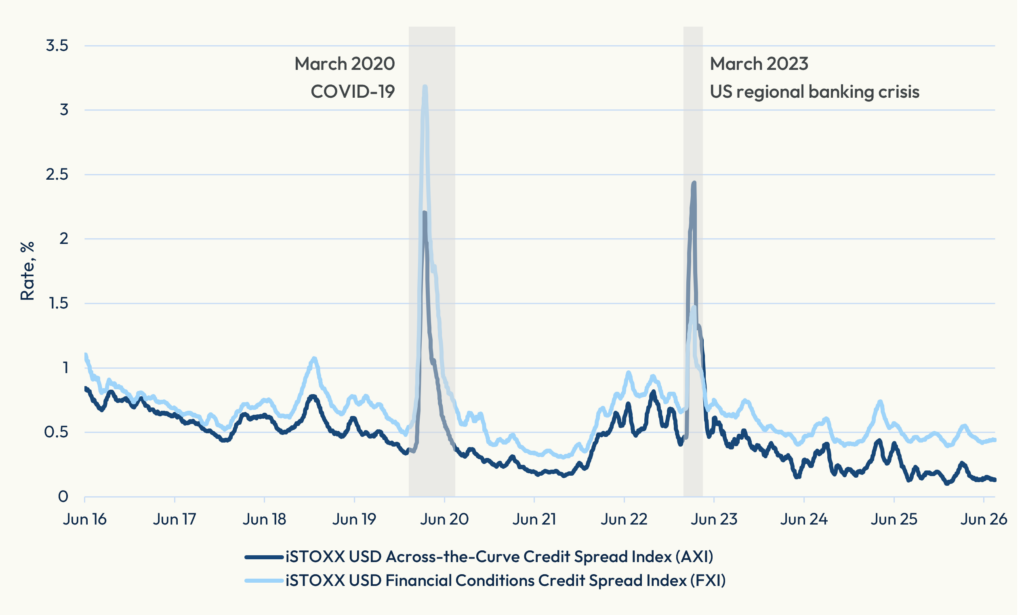
This is where USD AXI and USD FXI can play a vital role, supplementing SOFR and capturing the funding and credit-risk information that a risk-free rate structurally cannot. This combination would reduce the dislocation between a loan’s contractual reference rate and a lender’s real, current funding costs, making credit provision more robust precisely under stress.
“Credit spreads are not merely measures of expected default risk,” Roever wrote. “They are also real-time indicators of market liquidity, which is often a function of refinancing conditions, bank funding pressure, and the capacity of the financial system to transmit credit to the real economy. For policymakers and market participants focused on financial stability, this makes short-duration credit and funding spreads especially informative.”
A call for industry clarity
With the LIBOR transition complete, the benchmark-reform conversation should now shift toward distinguishing well-designed, transparent, transaction-based credit-spread supplements like USD AXI and USD FXI from less robust alternatives, Roever argued. He wrote that a genuinely resilient SOFR-centered system needs this additional layer of credit-risk measurement rather than relying on a risk-free rate alone — especially as financial risks increasingly arise from multiple channels, including private credit, nonbank financial intermediation and geopolitical uncertainty.
“AXI and FXI are designed to serve that purpose,” Roever said. “Used alongside SOFR, they can help lenders, borrowers and policymakers observe and manage the transmission of credit and funding stress across the financial system.”
We invite you to read the full article below and to return to this blog in the coming weeks for more coverage of the USD AXI and USD FXI indices.
Credit Spreads, Financial Stability, and the Next Stage of Benchmark Reform
[1] STOXX Ltd. is recognized as a third-country benchmark administrator under Article 32 of the EU Benchmarks Regulation and is supervised by the European Securities and Markets Authority (ESMA), providing an established regulatory framework for the administration of the indices in Europe. Further information on the governance, oversight and compliance framework for AXI and FXI is available in STOXX’s June 30, 2026 Governance, Oversight and IOSCO Compliance Framework letter.
[2] The AXI and FXI methodologies draw on the academic work of Antje Berndt, Darrell Duffie, and Yichao Zhu.
[3] Alex Roever is Senior Advisor to SOFR Academy, an American financial market infrastructure company. He previously spent more than 25 years at J.P. Morgan Securities, where he served for nearly a decade as Managing Director and Head of US Interest Rate Strategy. Mr. Roever represented J.P. Morgan on the Financial Stability Board’s Market Participants Group, which was charged with recommending enhancements to major interest rate benchmarks, including IBORs, following the Global Financial Crisis. He is a CFA Charterholder and has also served as a Senior Director at CFA Institute.