
Ten years after being demoted to Emerging Market (EM), Greek equities will be upgraded back to Developed Market (DM) status this month, with nine companies entering the STOXX® Europe 600.
The reclassification, which was announced in April and becomes effective on September 21, sees National Bank of Greece, Eurobank and Piraeus Bank among companies joining the European benchmark, STOXX said in a statement on September 1. Their weights in the index will be announced on September 11. Nine Greek stocks will also enter the broad EURO STOXX® benchmark on September 21.
The country’s stocks will be eligible for the STOXX® DM World benchmark as of June next year and for upcoming reviews of the EURO STOXX 50®.
The remarkable turnaround in the Mediterranean nation’s markets reflects a profound transformation of the country’s public finances and capital markets since the sovereign debt crisis of 2015, which almost forced it out of the eurozone, ravaged its banking sector, brought a sovereign default, wiped out most of the value of Greek stocks and prompted the Athens Stock Exchange to suspend trading for five weeks.
STOXX demoted Greece to EM in September 2016, the first such downgrade in STOXX’s classification history, after the Greek government imposed capital controls to stem money outflows.
New constituents
STOXX Europe 600
National Bank of Greece
Eurobank
Piraeus Bank
Alpha Bank
Public Power
Metlen Energy & Metals
GEK Terna
Motor Oil (Hellas)
Jumbo
EURO STOXX
Metlen Energy & Metals
National Bank of Greece
GEK Terna
Jumbo
Motor Oil (Hellas)
Public Power
Eurobank
Alpha Bank
Piraeus Bank
STOXX country classification
On September 21 this year, 26 of the 62 countries in the STOXX index universe will be classified as DMs and 19 as EMs. Seventeen are uncategorized.
The STOXX market classification model relies on an objective methodology that considers six criteria for the classification of a country as a developed marked — listed below — for which data is sourced from independent global organizations.
- Macroeconomic data
- Market capitalization
- Market liquidity
- Free currency convertibility on onshore and offshore markets
- Restrictions on capital flows
- Governance score based on political stability, control of corruption and regulatory quality.
Fall and recovery
The STOXX® Greece Total Market index slumped 95.4% between its October 2007 peak and February 2016, and remains two-thirds below its record despite a strong run this decade (Fig. 1).
Figure 1: >20-year performance
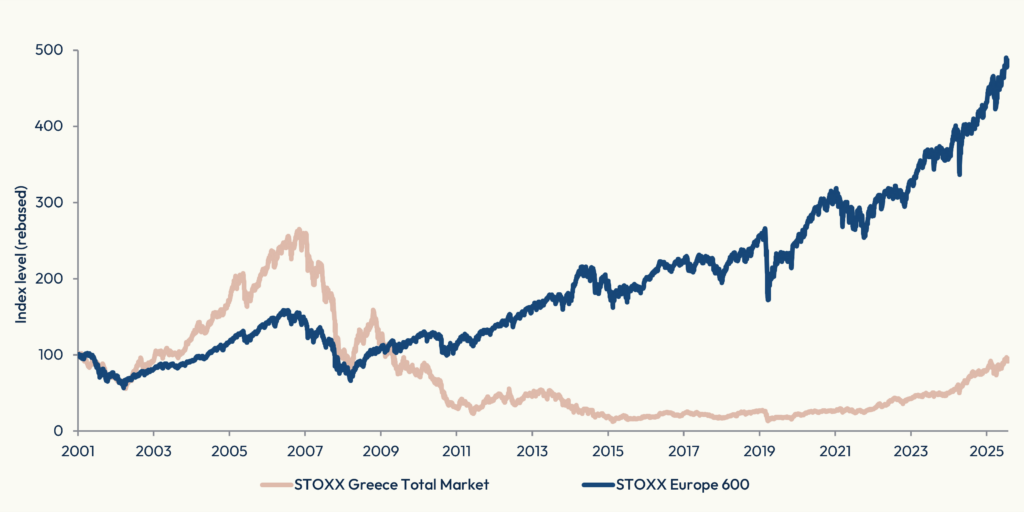
Source: STOXX. Gross returns in euros from December 27, 2001, to July 24, 2026. Rebased to 100 at start of period.
However, investors have returned to Greek stocks more recently. The Greek index has risen 280% in the past five years, compared with a 64% advance for the STOXX Europe 600 (Fig. 2)[1].
Figure 2: 5-year performance
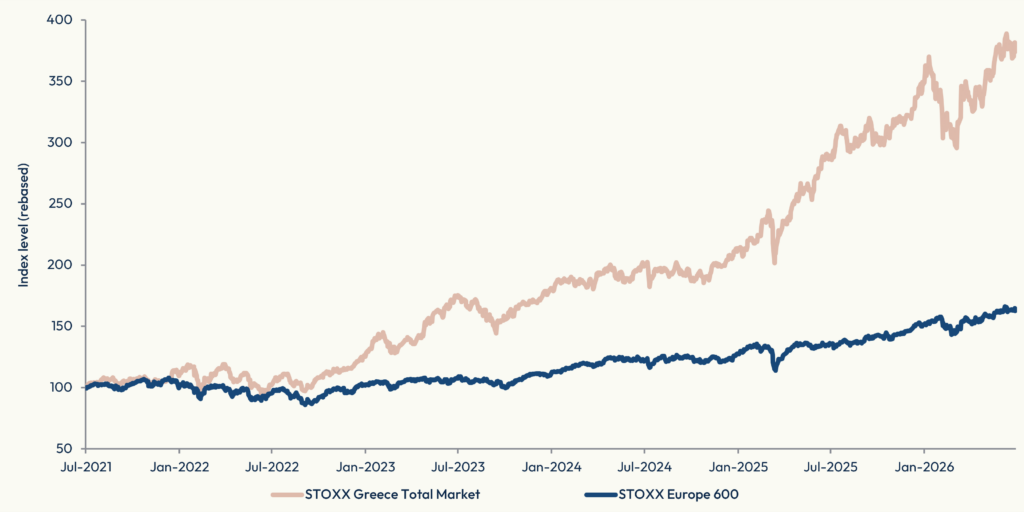
Source: STOXX. Gross returns in euros from July 26, 2021, to July 24, 2026. Rebased to 100 at start of period.
From crisis to full market rehabilitation
The Greek economy has outgrown the Eurozone average every single year since 2021.[2] The nation’s government debt-to-GDP ratio has fallen from 207% in 2020 to 146.1% in 2025, and is projected to decline further to 136.8% this year.[3]
Meanwhile, Greece has gradually returned to economic and financial normality. It exited an EU bailout program in 2018 and the EU’s special “enhanced surveillance” regime four years later. Capital controls were fully lifted in September 2019. Between 2023 and 2025, Greece’s sovereign bonds, rated as “junk” since 2010, regained investment-grade status from the three main rating agencies.
Incoming flows
The classification of a national market as EM or DM has an impact on investment flows, given the growth in recent years of exchange-traded funds that track indices. JPMorgan estimated in a July 6 note that the inclusion into the STOXX Europe 600 could represent USD 957 million in total net flows for nine Greek stocks.[4]
Establishing clear rules and actively monitoring structural and economic developments in countries is key for index providers to give market participants an investment framework they can rely on.
[1] Gross returns from July 26, 2021, to July 24, 2026.
[2] Source: Eurostat.
[3] Source: Greece’s Public Debt Management Agency.
[4] JPMorgan, Global Markets Strategy, “Greece: Raise to OW ahead of Eurostoxx entry in September,” July 6, 2026.