By Justus Weißmüller, Senior Associate, STOXX Product Development, DAX Benchmarks
Ask most investors what’s driving Germany’s stock market to record highs, and they’ll name the usual suspects: industrial giants, software leaders, defense contractors. But beneath those headlines lies a different story — one that’s been building for months.
Scattered across the country’s DAX®, MDAX® and SDAX® indices is a cluster of specialized companies tied to the global race to build semiconductor capacity. Together, they rank among the best-performing stocks on the Frankfurt Stock Exchange in 2026.
Nineteen of the 160 companies in the DAX® All Cap index — the combined universe of DAX, MDAX and SDAX constituents — have gained 50% or more over the past twelve months. Nine of those 19 have business models related to the global chip industry.
Figure 1: DAX All Cap constituent returns
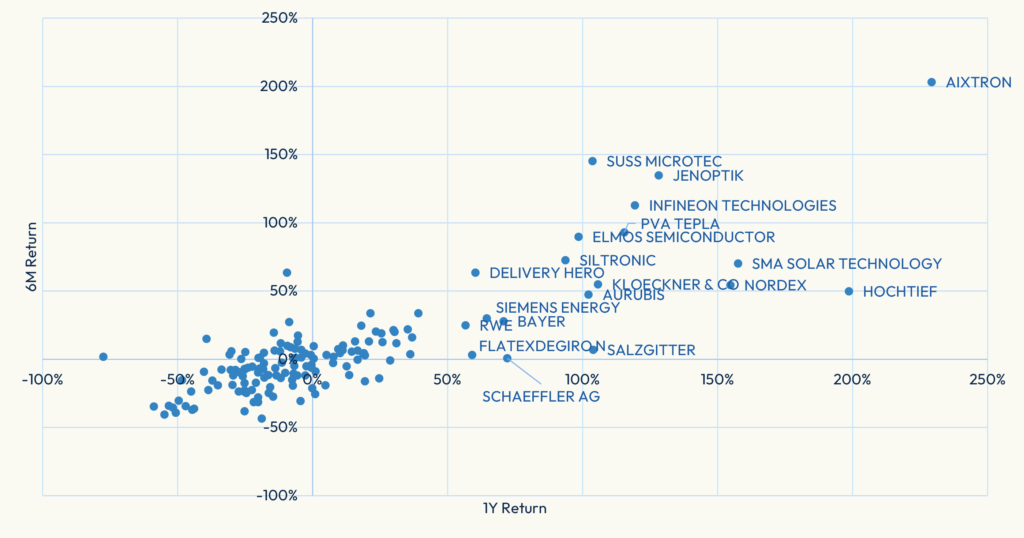
Source: STOXX. Data through June 30, 2026.
These nine companies aren’t all part of any one index. They’re spread across DAX, MDAX and SDAX, which suggests this isn’t a niche phenomenon but a broad-based structural trend running through the German economy.
Figure 2: Chip-related returns
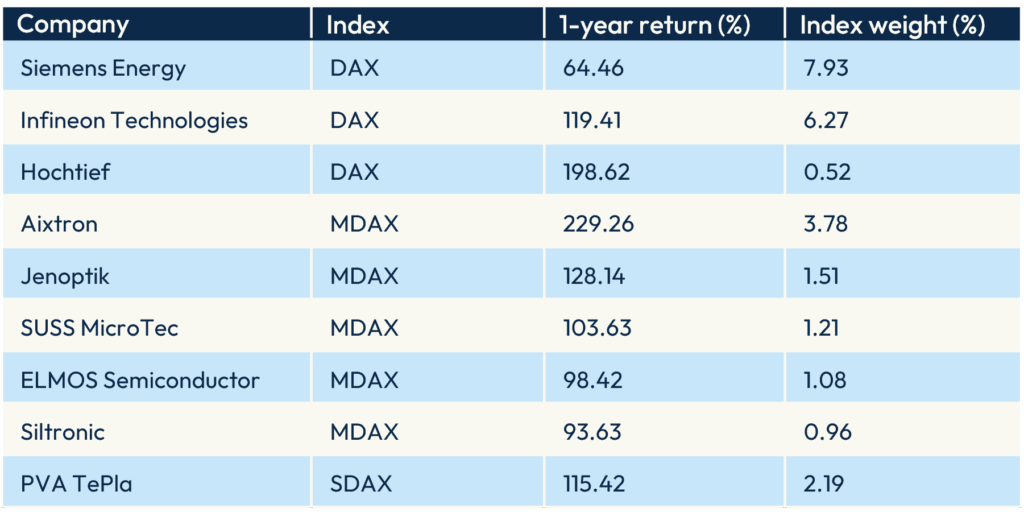
Source: STOXX. Data through June 30, 2026.
That’s a remarkable concentration of chip industry exposure for an economy more commonly associated with cars, machinery and chemicals. Semiconductors, it turns out, may be one of Germany’s best-kept market secrets right now.
Lifting MDAX
Within the DAX itself, Infineon Technologies, a semiconductor manufacturer, and Siemens Energy, an energy technology supplier benefiting from growing demand for data centers, have been standout performers, together accounting for a large share of the index’s advance to an all-time high in 2026.
MDAX has climbed 3.8% this year, led by five constituents: Aixtron, Delivery Hero, Jenoptik, Hochtief and Salzgitter.1
Two of these — Aixtron and Hochtief — are direct semiconductor beneficiaries, each contributing more than 2 percentage points to MDAX’s year-to-date return. Hochtief’s rally was strong enough to earn it a promotion to the DAX at the June index review, a notable vote of confidence from the market on the group’s AI data-center construction business. Aixtron is a provider of deposition equipment to the semiconductor industry.
If MDAX reflects semiconductor strength as part of a broader rally, the SDAX is, to a remarkable extent, a semiconductor story. The small-cap index is up 5% year-to-date, and virtually the entire gain can be traced to four companies: SUSS MicroTec, Siltronic, Elmos Semiconductor and PVA TePla — all four directly exposed to the chip industry.
Their gains have been strong enough that three of them — SUSS MicroTec, a semiconductor equipment manufacturer; Siltronic, a provider of high-tech wafer solutions; and Elmos, a semiconductor manufacturer — were promoted to MDAX at the June index review, leaving PVA TePla, another chip equipment manufacturer, as the only remaining pure-play semiconductor company in the small-cap index.
Global buildout
Strip away the index-level headlines and a clear pattern emerges: Germany’s semiconductor supply chain — equipment makers, materials suppliers and chip designers — is having an exceptional year, and it’s showing up at every level of the German stock market, from blue-chip DAX constituents like Infineon down to SDAX companies most investors have never heard of.
The race to ramp up chip manufacturing capacity isn’t just a story about Taiwan, the US or South Korea. Germany’s specialized equipment and materials companies — the unglamorous but essential suppliers to the world’s chipmakers — have quietly joined the global boom.
1 Gross returns in EUR through June 30, 2026.