
The STOXX Thematic index suite continues to expand, covering an ever-growing set of investable themes, many tied to the megatrend of future technology.
The latest example comes with the introduction of the STOXX® Global Space Satellites and Drones index, which targets a strategic theme amid increasing demand for, and commercialization of, global connectivity, navigation, Earth observation and AI‑powered analytics. The index underlies the iShares Space Technologies UCITS ETF (STAR) from BlackRock as of June 9.
Why space, satellites and drones?
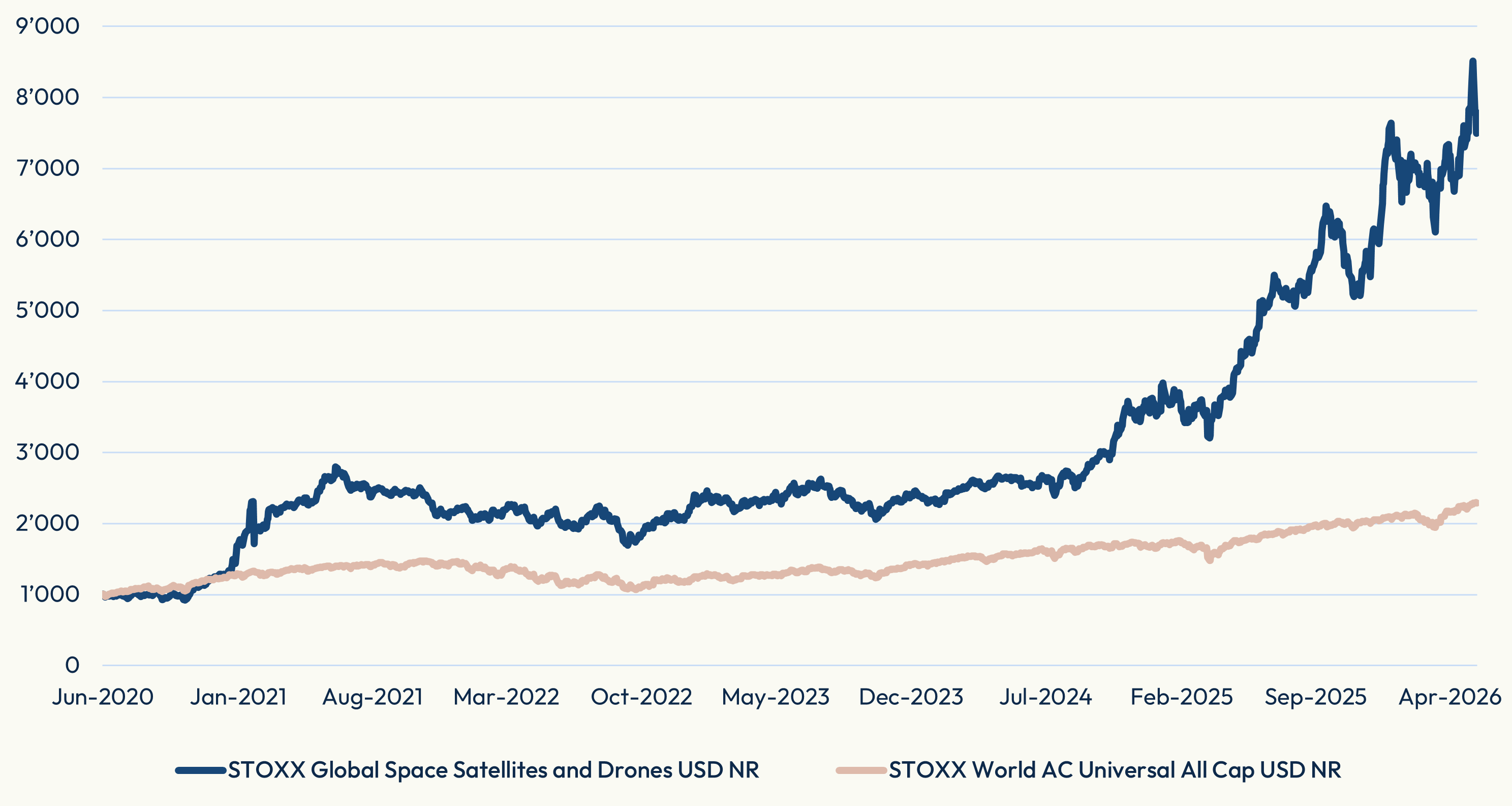
Shares related to space technologies have been standout performers in recent months as investors weigh the possibilities the companies open for industries ranging from transportation to agriculture, defense and digital services. The STOXX Global Space Satellites and Drones index has risen 112% since the start of 2025, outperforming the STOXX® World AC Universal All Cap benchmark by 75 percentage points (Fig. 1).[1]
Fig. 1: Performance
The use of drones has expanded well beyond defense into sectors such as agriculture, energy and logistics. Satellites underpin global communications and navigation and have increasingly been deployed to deliver commercial broadband services. Space is also attracting AI infrastructure developers, as its natural cooling conditions and continuous access to solar energy could make it an attractive environment for future data centers.
McKinsey & Co. estimates that the global space economy will reach USD 1.8 trillion by 2035, up from USD 630 billion in 2023.[2] This includes “backbone” applications (satellites, launchers, GPS, broadcast) and revenue streams for industries using satellite-based capabilities. According to the consultancy, the space economy is already comparable in size to the semiconductor industry.
“As launch costs fall and satellite adoption rises, the space economy is becoming an increasingly important long-term investment theme,” said Omar Moufti, thematics and sectors product strategist at BlackRock. “STAR captures the full space value chain, spanning rockets, satellites and autonomous technologies, with each layer supporting the next. STAR’s fast-track access and thematic purity create a differentiated way to participate in this expanding opportunity set.”
Methodology
For more than 15 years, STOXX has been a pioneer in thematic investing, utilizing innovative and diverse datasets alongside proprietary methodologies to capture disruptive growth trends within robust, investable frameworks. This requires moving beyond conventional sector and revenue classifications and embracing forward-looking approaches.
The STOXX Global Space Satellites and Drones index is derived from the STOXX World AC Universal All Cap. All eligible securities must pass Controversial Weapons and Norms-based screening as determined by ISS Sustainability.
From there, companies are screened for the following:
- RBICS[3] revenue exposure to the targeted themes.
- Type of relationship with space agencies, leading private aerospace companies and “pure players” in the Space and Missile Equipment Manufacturing RBICS sector.
RBICS revenue exposure
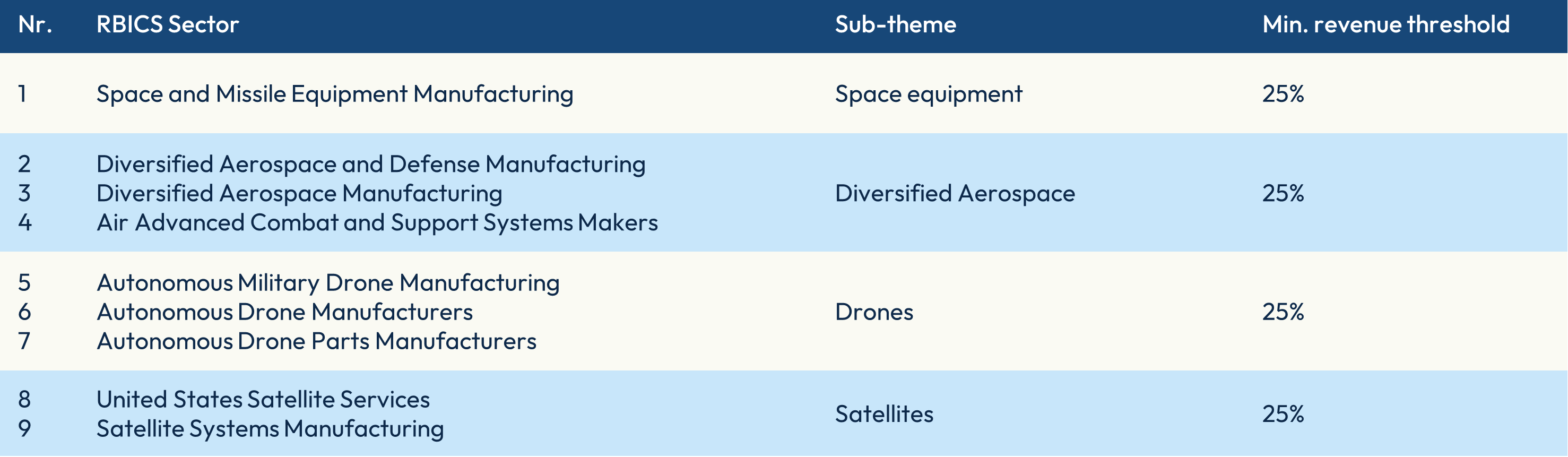
Nine RBICS sectors have been associated to four sub-themes:
- Space Equipment
- Diversified Aerospace
- Drones
- Satellites
Eligible companies are screened for their sales exposure to the aggregated RBICS sectors related to each sub-theme (Fig. 2). Those that meet a minimum revenue threshold of 25% of their respective sub-theme are selected.
Fig. 2: Associated RBICS sectors and sub-themes
Relationship screen
The second screen selects companies that are suppliers, competitors or partners of one or more of the following:
- Artemis Accords signatories.[4]
- National/acting space agencies representing those signatories.
- Key commercial contractors supporting Artemis-era lunar exploration.
- Companies deriving more than 95% of their revenue from the Space and Missile Equipment Manufacturing RBICS sector.
To qualify for selection, companies must generate at least 25% of their revenue from 34 aggregated RBICS sectors linked to the relationship chain. These sectors span a wide range of activities, including satellite systems manufacturing, aerospace and defense IT services, semiconductors, defense electronics, telecommunications infrastructure and quantum computing systems.
All securities that pass one or more of the selection screens 1 and 2 are included in the STOXX Global Space Satellites and Drones index. Constituents are subsequently classified into two tiers: Tier 1 includes companies that satisfy the RBICS revenue exposure threshold, while Tier 2 consists of all other eligible constituents.
“Space is a fast-evolving, cutting-edge investment theme, and we are delighted to collaborate with BlackRock,” said Axel Lomholt, General Manager at STOXX. “Leveraging STOXX’s established, leading expertise in thematic indexing, the STOXX Global Space Satellites and Drones index provides investors with an innovative way to access this dynamic opportunity.”
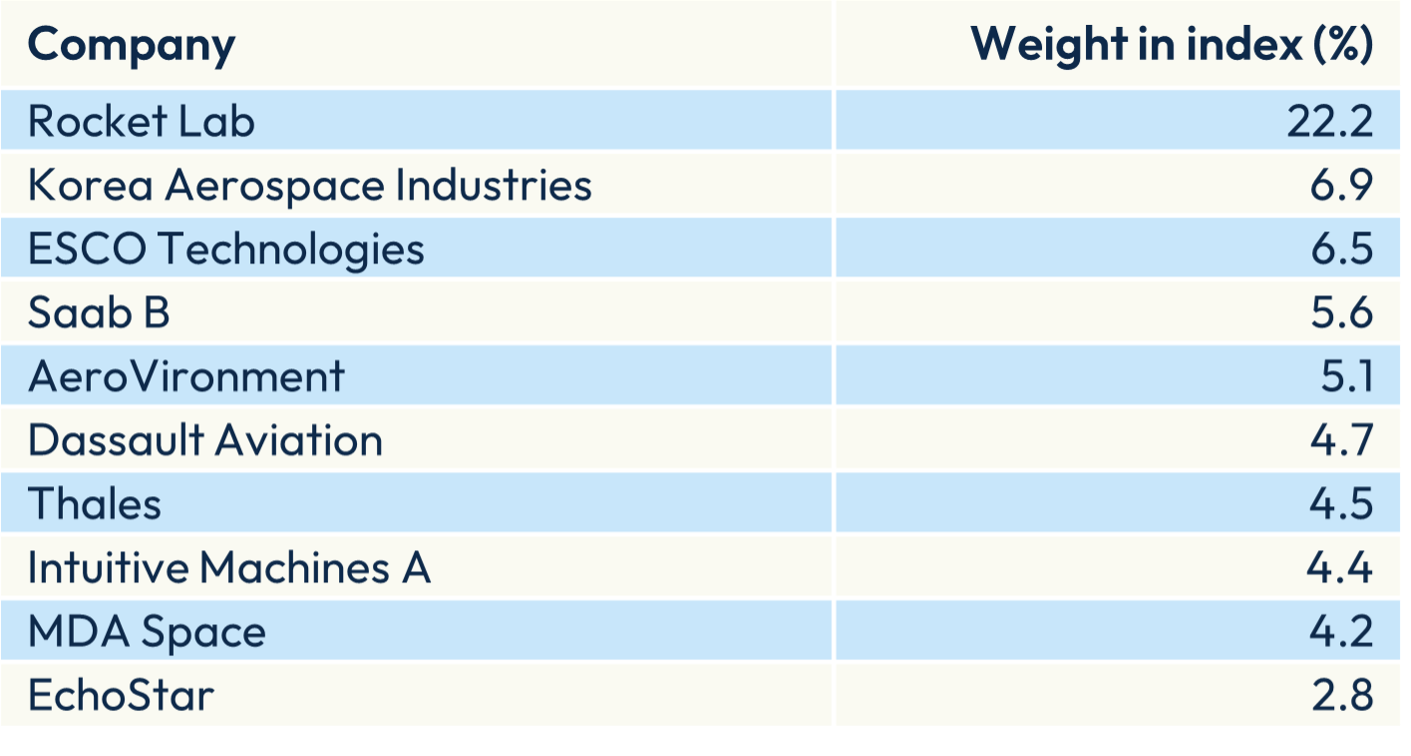
Figure 3 shows the current top holdings in the STOXX Global Space Satellites and Drones index.
Fig. 3: Top holdings
Reported SpaceX listing
The space theme in markets may be impacted by the anticipated listing of Space Exploration Technologies Corp. (SpaceX), reportedly aimed for June 12, which could become the largest IPO in history if completed as currently expected.[5]
Given its projected size, the company could enter the STOXX Global Space Satellites and Drones Index through the Fast Entry mechanism outlined in the index methodology. Under the mechanism, companies on the STOXX IPO selection list may be considered for index inclusion provided they satisfy the following conditions:
- They qualify for the Space, Drones and Satellites theme.[6]
- Their free-float market capitalization ranks among current Tier 1 constituents.
Newly floated companies that meet these criteria may be added according to a timetable based on Date t (the listing date) and Date T (the index annual review effective date, currently June 22). Assuming a June 12 listing date for SpaceX, the following timeline could apply under the current methodology framework:
- If STOXX becomes aware by T-5 (June 15) or earlier that the IPO will occur during the review month, the company may be added through an ad-hoc index review.
- The review announcement would occur on Date t (June 12).
- The index inclusion announcement would take place on Date t+5 (June 19).
- The inclusion would become effective on Date t+10 (June 26).
If the listing is delayed beyond the review month, STOXX would determine the timing of any ad-hoc review.
This timeline example is based on assumptions. There is no guarantee that this process will occur as outlined until the SpaceX IPO is formally completed, and STOXX confirms eligibility and implementation details.
Disruptive trends as investable frameworks
The STOXX Thematic indices are designed to reflect how megatrends are reshaping markets. The STOXX Global Space Satellites and Drones index extends the offering’s thematic coverage into a new segment of technological development, providing precise exposure to companies operating across the value chain in one of the most dynamic and important areas of innovation.
[1] Source: STOXX. Net returns in USD through June 4, 2026.
[2] McKinsey & Co, “Space: The $1.8 trillion opportunity for global economic growth,” April 8, 2024.
[3] FactSet Revere Business Industry Classification System. RBICS Revenue and Supply Chain Relationships datasets provide detailed insights into the revenue sources and supply-chain relationships of companies.
[4] The Artemis‑era space ecosystem refers to the broad, interconnected network of technologies, organizations, infrastructure and economic activity emerging around NASA’s Artemis program, which aims to establish a sustained human presence on and around the Moon and use it as a stepping stone to Mars.
[5] Bloomberg, “What to Know About the SpaceX IPO,” May 29, 2026.
[6] The determination of whether a company qualifies is based on STOXX internal research.